
A Bird Hit Your Window: What to Do in the Next Hour
A bird hit your window and is still alive: how to tell dead from stunned, why a rehabilitator beats a shoebox, and why one that flew into glass gets no water.
A bird hit your window and is lying on the ground. Check whether it is alive by gently moving its legs, then get it to a wildlife rehabilitator if you can reach one. If you cannot, a dark box in a quiet room is the fallback, and the bird gets no food and no water while it is in your care.
That order matters, and most advice gets it backwards.
A bird hit the window and is still alive, or is it already dead?
Move its legs. The answer comes back in seconds.
Rita McMahon, director of the Wild Bird Fund in New York City, gives the test to Audubon: Birds go into rigor exceedingly quickly, like in a matter of minutes, so If the legs don't move, the bird is dead. But if they move, the bird's just unconscious.
Telling the two apart is the most useful thing on this page. A stunned bird after a window strike can look exactly like a dead one: flat, still, eyes closed. Birds that would have recovered get buried every year because nobody checked, and the check costs nothing.
How to save a bird that flew into a window: the first ten minutes
Get it contained, then get it to someone licensed.
Audubon's handling instructions are specific. Approach slowly, perhaps from behind to avoid startling it, then Pick up the bird and put it into a paper bag or a shoebox. Without gloves, make sure your hands are clean to protect the bird's feathers, and wash them afterwards.
The container has a requirement that catches people out: Avoid transporting the bird in any container with holes, loops, or strings that can entangle its legs. A mesh produce bag or a tote with a drawstring is worse than a plain paper sack.
The destination is a rehabilitator, not your kitchen. Sunny Kellner, wildlife rehabilitation and outreach specialist at Sharon Audubon Center, states the limit plainly: A lay person isn't going to know or recognize all the signs of various bird injuries and certainly wouldn't be able to provide the proper medical treatment. Audubon's conclusion follows from that, saying the best thing to do for a window-collision victim is to get the bird to a wildlife rehabber who can provide expert care and anti-inflammatory medication.
Glass leaves injuries you cannot see. Audubon notes that hitting glass often leaves birds with concussions, and that some have pelvic injuries from putting their legs out in a last-second attempt to avoid the window.
To find one: the Humane Society keeps a state-by-state list of rehabilitators, and Animal Help Now searches by location.
What if you cannot get to a rehabilitator?
Then the box, and an hour of being left alone.
Audubon frames this as the second choice: if you can't get the bird to a wildlife rehabber, the next best thing is a safe place away from predators, hypothermia, and other hazards. In practice that means a paper bag or shoebox in a dark, quiet room in your house away from pets and people, and then Leave the bird undisturbed for about an hour.
Check by ear. McMahon's method: Then listen, and If you hear that bird tap-dancing around inside, he's feeling better. Opening the box to look undoes the quiet the bird is using.
On timing, two authorities give different numbers, and both are worth having. The Cornell Lab of Ornithology expects a dazed bird to revive within a few minutes, unless it is seriously injured and advises to Release the bird as soon as it appears awake and alert. Audubon's hour is the more conservative figure. A glancing knock and a hard strike are not the same injury, so treat the range as the range and let the listening decide.
Audubon also records the honest limit on doing this at home. Jenith Flex, a board member with Lehigh Valley Audubon Society and a volunteer wildlife rehabilitator, notes that releasing a bird this way doesn't guarantee it has recovered, since it hasn't had expert care. It is a way to help when a rehabber isn't an option.
One more instruction, and it runs against instinct: Resist any urge to extensively interact with the bird. Less is more.
Why should you never give a stunned bird water?
Because it can go into the lungs.
Audubon states the mechanism and closes off the worry behind the question in the same breath: Don't try to feed the bird or give it water, either. Putting water down a bird's throat can cause it to aspirate. It will be okay without food or drink for the brief time it's in your home.
A concussed bird has impaired reflexes, which is exactly when aspiration is most likely. The kindest-looking action on the list is the one that can finish what the window started, and the bird is in no danger from an hour without a drink.
Is this a big-building problem or a backyard problem?
Backyard, overwhelmingly.
Audubon's figures: Each year between 365 million and 1 billion birds die from collisions with windows across the United States, and The overwhelming majority of those window strikes occur at residential and low-rise buildings, with fewer than 1 percent caused by skyscrapers.
Under 1 percent from skyscrapers. The mental image of this as a downtown problem is close to the opposite of the truth, and it means the windows that matter most are ordinary house windows, including the one you watch your feeder through.
Why did the bird hit your window at all?
Two different failures, needing opposite fixes. Cornell's diagnostic is to stop looking at the glass from inside and go stand where the birds are.
See-through glass. The bird reads a route where there is a barrier: Go to your feeder and look at your window. Can you see through it? If so, the birds can, too. Cornell's follow-up questions are worth walking through: is there a plant or something else inside the house that might be attractive to birds, and is there another window on the opposite side of the house that makes the building look like a corridor.
Reflective glass. The bird sees habitat because habitat is what the glass is showing it: If you see branches or sky reflected in the glass when you look at your windows, you'll understand why the birds are confused.
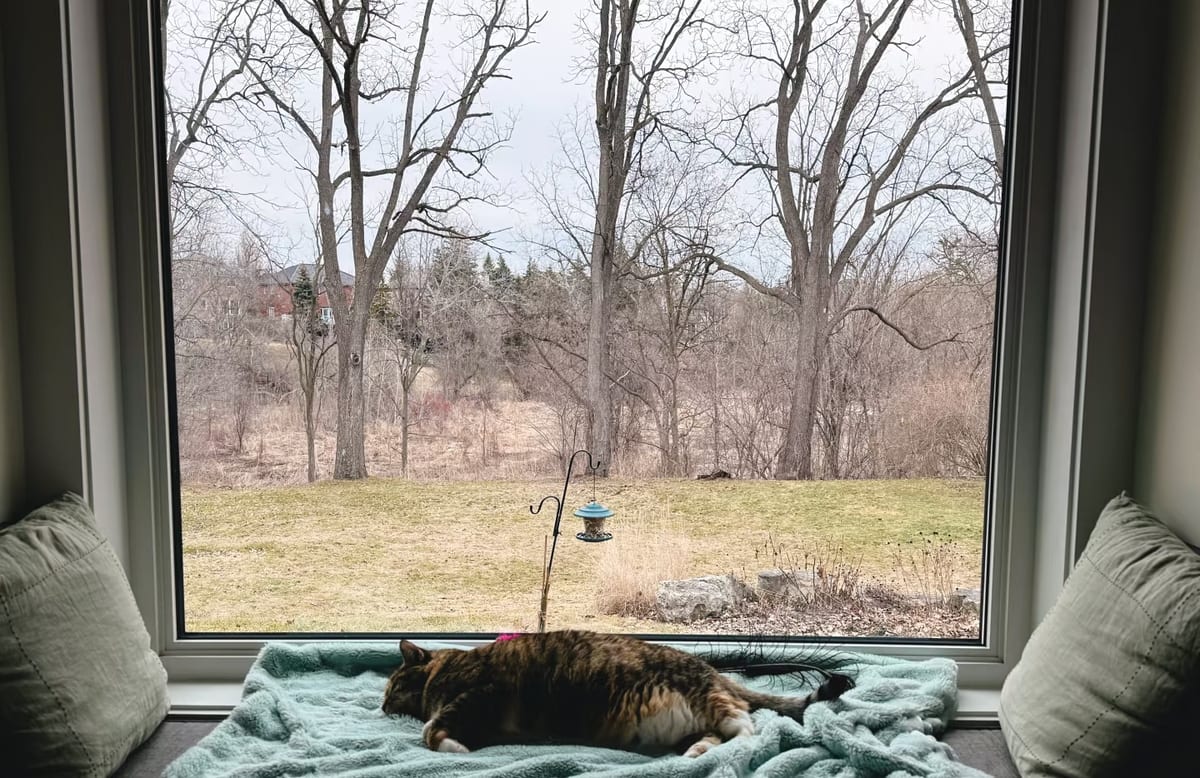
Inside or outside: where window film for birds actually goes
Outside. A treatment on the inner surface is the most common reason a well-meant fix changes nothing.
Cornell explains why an inside treatment cannot fix a reflection: when branches or sky are mirrored in the glass, changing the lighting inside the house or fastening objects to the inside of the glass won't help. The bird is looking at the outer surface. Everything behind it is hidden.
The American Bird Conservancy reaches the same place from the product side: It may be tempting to place bird-friendly window products on the inside of windows, but this should be avoided whenever possible, because Applied internally, the treatment is invisible to birds when window reflections outside are strong.
Decals stuck to the inside of a picture window are the most common version of this mistake.
For windows you genuinely cannot reach from outside, ABC gives a test instead of a rule. Apply the proposed inside solution, then observe the window from outside every two to three hours starting in the early morning to judge its visibility. If you can clearly see your test solution, birds might too. And the test material should be obvious: Your test solution should be something large and bright, like Post-It Notes, so that it has a chance to be visible through the reflections on the outside of the glass.
Window decal spacing to prevent bird strikes
Two inches or tighter, in marks big enough to register.
ABC's current standard: Ideal spacing follows the two-inch-by-two-inch rule. Patterns that have vertical, horizontal, or diagonal spaces of two inches or less will prevent most collisions. The reason for the tight number is body size: Larger spacing poses a risk to small songbirds, including hummingbirds, that can easily fly through four-inch-wide gaps.
Minimum dimensions for the marks themselves: If your pattern consists of stripes, they should be at least one-eighth of an inch wide. If you use dots or similar shapes, they should be at least one-quarter of an inch in diameter.
And a check anyone can run: You should be able to see the pattern clearly from 10 feet away, because birds need to detect patterns from far enough away to change course.
Where the sources disagree, and which one to follow. Audubon's 2021 article passes on a suggestion from Flex to draw vertical lines across the outside of the whole window with a glass pen and a ruler, four inches apart. ABC's guidance says four-inch gaps are exactly what small songbirds and hummingbirds fly through. The two are answering slightly different questions, one about a cheap method most people will actually do and one about the spacing that works across all species, but if you are marking a window this weekend, mark it at two inches. The tighter standard costs the same pen.
To turn the two-inch rule into a count for a particular pane, we built a spacing calculator that does the arithmetic and cites the same ABC figures.
Before you stick anything to the glass: Cornell warns not to attach objects directly to thermopane windows without consulting the manufacturer.
Which windows should you treat first?
You probably do not need to do the whole house. ABC's triage list starts with windows that have already caused collisions, then large windows and glass doors that reflect habitat or let you see through to sky and greenery, then Windows across from bird feeders, bird baths, and fruit-bearing plants. In many cases, fixing only those windows will stop almost all collisions.
That third category is the one this site cares about, and it is also the cheapest to fix without touching the glass at all: move the feeder. Cornell notes that Usually bird strikes occur at just one or two windows. Moving feeders away from them may solve the problem entirely.
Distance works at both extremes. Audubon's version: place feeders and bird baths either within three feet of windows, so birds can't gather much speed before hitting, or more than 30 feet away. Cornell gives the mechanism for the near option, noting that a feeder a foot or two from the glass still gets panicked birds flying into the window, but they probably won't have enough momentum to injure themselves. Those numbers have a specific research origin and a wrinkle worth knowing about, which is covered in the three placement constraints that pull against each other. One extension service takes the opposite position on feeders near glass, arguing that proximity raises the risk rather than lowering it, and that disagreement is worth seeing in full. Anyone feeding from a window feeder or an apartment balcony is already at the safe end of that range without trying.
What works, what helps a little, and what does not
| Works | Helps a little | Does not work |
|---|---|---|
| Patterns on the outside, gaps of 2 inches or less | Closing blinds | Decals inside against a reflective window |
| Dots at least ¼ inch, stripes at least ⅛ inch, visible at 10 feet | UV-reflective film (birds see more of it than we do) | One hawk silhouette on a large pane |
| Moving the feeder to under 3 feet or over 30 feet | The Post-It test for unreachable windows | Marks too small or too far apart |
| Checking for rigor before assuming death | An hour in a dark box | Offering food or water |
| Getting the bird to a licensed rehabilitator | Handling, petting, and talking to it |
What if the bird died?
Some strikes are not survivable, and nothing you did in the moment changed that.
If you want the loss to count for something, Audubon notes that If you find a bird that you suspect has been killed by a building strike, you can contribute to research that might help save birds in the future, by reporting it on iNaturalist or NYC Audubon's dBird database. Those records are what conservationists take to building managers when they ask for glass to be made safer.
Handle the body the way you would handle any dead bird in the yard, with gloves or a bag over your hand, and check whether your state wants it reported.
One case that looks like a strike and is not: a bird that returns to the same pane again and again, fluttering and tapping without ever being hurt, is fighting its own reflection rather than failing to see the glass. The fix there is different, and it is not urgent.
A bird that came through an open door instead of into the glass is also a different situation, and mostly a calmer one: the room itself does the work.
Questions people ask
How do I help a bird that flew into a window and is still alive? Move it out of reach of cats, keep it dark and quiet, and call a licensed rehabilitator. Do not offer water. The full sequence is in the first section above.
Birds keep running into my window. What should I do? Running into the glass is the collision case this article covers, and the response depends on the bird. If one is on the ground, start with the first-aid sequence above. If it is happening repeatedly to different birds, the glass needs treating on the outside. A single bird that returns day after day and is never hurt is doing something else entirely, and that is attacking its own reflection.
What do I do if a bird hits my window and is still alive? Move its legs to confirm it is unconscious and not dead, put it in a paper bag or shoebox with no holes or strings, and get it to a licensed wildlife rehabilitator. If that is not possible, leave it in the closed box in a dark, quiet room away from pets for about an hour, with no food and no water.
How can I tell if a stunned bird is dead? Gently move its legs. Rita McMahon of the Wild Bird Fund says birds go into rigor within minutes, so legs that do not move mean the bird has died, and legs that move mean it is unconscious.
Should I give a stunned bird water? No. Audubon warns that putting water down a bird's throat can cause it to aspirate, and that the bird will be fine without food or water for the short time it is with you.
How long does a stunned bird take to recover? The Cornell Lab expects a few minutes for a bird that is not seriously injured. Audubon suggests about an hour. Listen for movement inside the box instead of opening it.
Do window decals actually work? Only on the outside of the glass, and only when spaced two inches apart or less. American Bird Conservancy notes that treatments applied inside are invisible to birds when outside reflections are strong.
Why do birds keep hitting the same window? That window is either transparent enough to look like a way through or reflective enough to look like habitat. Cornell's test is to stand at the feeder and look back at the glass.
Are most window strikes at tall buildings? No. Audubon reports that the overwhelming majority happen at residential and low-rise buildings, with fewer than 1 percent caused by skyscrapers.
A bird hit your window: the short version
Move the legs to find out whether it is dead or unconscious. If it is alive, a paper bag with no strings and a licensed rehabilitator, in that order, with the dark quiet box as the fallback when no rehabber is reachable. No food, no water, no handling, and check by listening.
Then go stand at your feeder and look back at the window. If you can see through the house, so can they. If you see sky and branches in the glass, the fix has to go on the outside, at two-inch spacing, in marks you can pick out from ten feet.
And if the strikes cluster at one pane, moving the feeder costs nothing at all. A bird hit window is treated at the glass, not at the feeder, and the glass is the part you can fix once and forget.
The photograph in this article was taken by our contributor yuanyuan and is used with permission. More on where our photographs come from.