
Where to Put a Bird Feeder: Three Rules That Contradict Each Other
Where to put a bird feeder: ten feet from squirrel launch points, close to cover, and either right against the glass or well away from it. The rules conflict.
Advice on where to put a bird feeder usually arrives as a single confident number. Ten feet from the trees. Or three feet from the window. Or right next to a shrub. Each of those is defensible on its own, and they were written by people solving different problems.
Put them side by side and they do not fit together. One rule pushes the feeder away from vegetation, the second pulls it back toward vegetation, and the third rules out an entire band of distance from your house. There is no position that satisfies all three, which means the thing worth understanding is what each rule protects against, and what you give up when you break it.
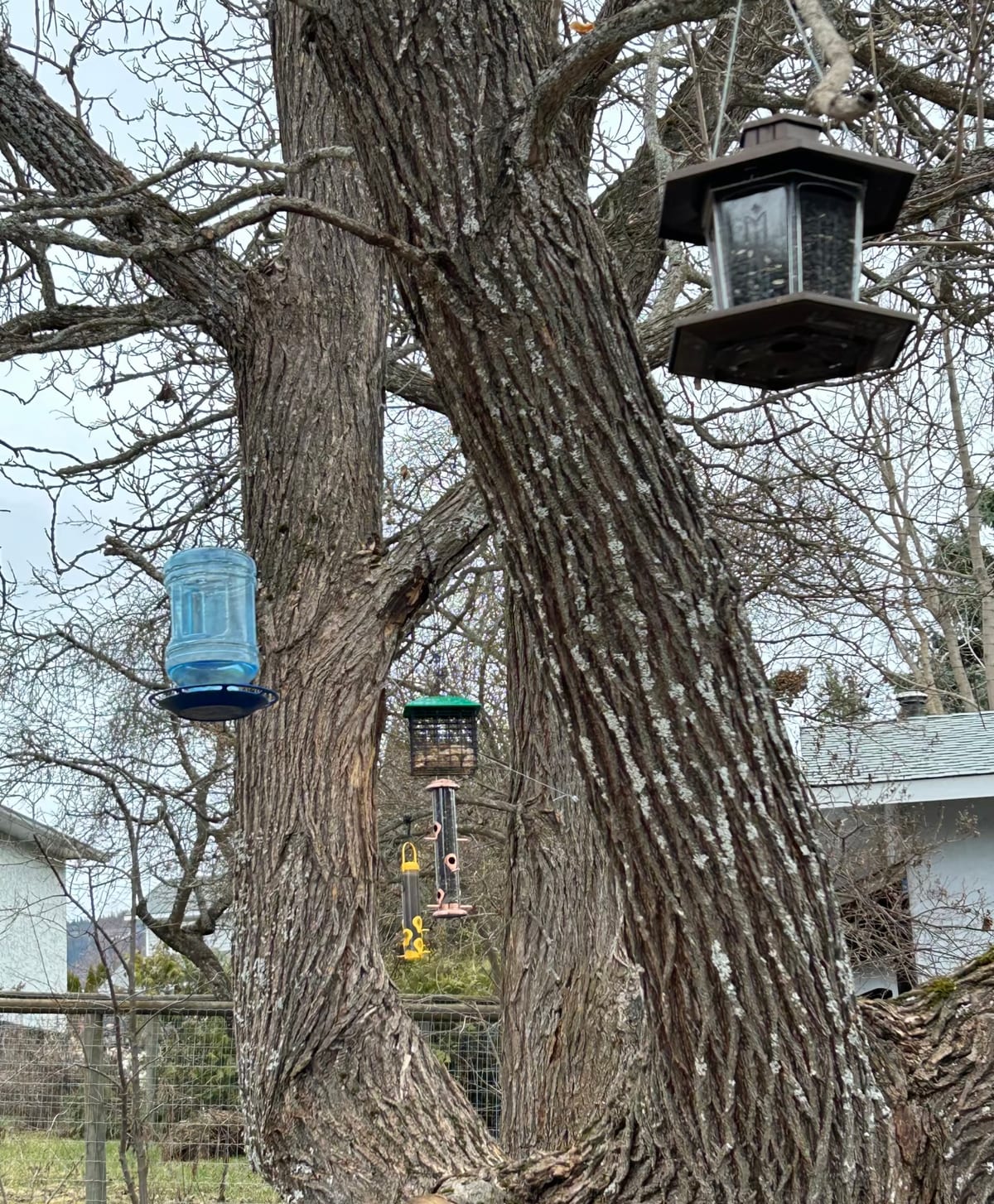
Rule one: about ten feet from anything a squirrel can jump from
Project FeederWatch states the constraint plainly: However, squirrels can jump to feeders placed less than ten feet from a tree or building. That covers trees, walls, fences, railings, and rooflines.
Note that the same sentence covers the animal most people forget. FeederWatch's warning about placement is about jump-off points for squirrels and cats, and a cat that can reach the feeding station is a different order of problem from a squirrel that can. Clearance is doing double duty here, which is why it belongs with the rest of the uninvited visitors rather than with the hardware. The cat half of that rule has its own article, including what the research actually attributes to pet cats.
This rule wants the feeder standing alone in open space.
Rule two: close to cover, because birds need somewhere to go
Now the opposite instruction, from the same organization: Place feeders close to natural cover, such as trees or shrubs, which offer refuge to birds as they wait their turn to feed.
A feeder in the middle of an open lawn is exposed. Small birds want a branch to wait on and somewhere to bolt to when a hawk goes over. Take away the cover and you have built something safe from squirrels that birds are reluctant to use.
FeederWatch does not pretend these two rules coexist. It names the conflict and splits the difference: Be careful not to place feeders too close to cover with strong branches that can provide good jump-off points for squirrels and cats. A distance of about 10 feet seems to be a good compromise.
That word, compromise, is doing real work. Ten feet is not a safety threshold. It is the distance chosen to be far enough from the branch and close enough to the shrub, and the source says so.
A camera adds a fourth constraint that fights the other three, since it needs light and wifi, and the three places those demands conflict with the rules above have their own article. What the hardware is and what it costs is in smart bird feeders. If you would rather do the looking yourself, the position that suits your own sightline is governed by what your optics can resolve.
Rule three: bird feeder distance from window is not what you think
The third constraint has nothing to do with squirrels and much higher stakes. Glass kills birds at a scale that is difficult to hold in your head. The American Bird Conservancy puts it at More than 1 billion birds die from collisions with glass every year in the U.S. alone, and Audubon reports the same order of magnitude: Research indicates that more than one billion birds may be killed per year in the United States alone as a result of collisions.
The reason is not carelessness on the bird's part. As Audubon describes it, Birds don't 'see' glass the way we do and may fly into windows and other surfaces that reflect the surrounding landscape or try to fly through glass that appears transparent and invisible.
A feeder concentrates birds near your house and then startles them at intervals, which is exactly the condition that turns a window into a hazard.
The counterintuitive fix is to move the feeder closer rather than further. Audubon heads the recommendation "Place bird feeders directly on windows" and explains it underneath: Research has shown that feeders closer than three feet prevent birds from building up enough momentum to harm themselves if startled.
The Cornell Lab of Ornithology gives the same mechanism with a tighter number: Place feeders closer to the glass. If a feeder is just a foot or two from a window, panicked birds may still fly into it, but they probably won't have enough momentum to injure themselves.
Both are describing the same physics. A bird leaving a feeder one foot from the glass is still accelerating when it arrives. It bumps. A bird leaving a feeder some distance away arrives at full speed. That difference has been measured rather than assumed, and the next section is about the experiment that measured it.
Where the "3 feet or 30 feet" rule comes from, and what it leaves out
You will read almost everywhere that the rule is "within 3 feet or beyond 30 feet," with everything in between described as the dangerous zone. That formula has a real experiment behind it, which is worth knowing, because the experiment says something slightly different from the formula.
The source is a 2004 study in The Wilson Bulletin by Daniel Klem Jr. and colleagues at Muhlenberg College. Klem has been studying bird-glass collisions since the 1970s, and this particular paper moved feeders around and counted what happened. The finding: No fatalities were recorded when feeders were located within 1 m of a window, but a marked increase in mortality occurred when feeders were placed 5 and 10 m from the glass. The authors' recommendation followed directly: angling panes in new and remodeled buildings and placing bird feeders closer to windows can potentially reduce avian mortality.
So the close-to-the-glass half of the rule rests on measured mortality. Zero fatalities within a meter is about as clean a result as backyard advice ever gets.
It is not unanimous, though. Virginia Cooperative Extension publishes the opposite advice about feeders close to windows, and both positions are laid out side by side here.
Those distances are also what puts a deck railing in the untested middle. Now look at the distances the published finding names: 1 meter, 5 meters, and 10 meters. A later paper summarizing the same experiment describes the effect as an increase in the number of bird-window collisions when feeders were placed 2-10 m from a window, so the range Klem covered was wider than those three figures on their own suggest. Ten meters is 32.8 feet. The far end of that experiment sits almost exactly where the popular rule places safety, and it is the distance at which Klem recorded mortality going up.
Ten meters is the farthest distance the published finding reports. So the claim that 30 feet or more is safe sits beyond the end of the reported data, and the last point before it is the worst result in the experiment. It may still be sound: birds far enough from a house may well route around it rather than through it, and the Cornell Lab does confirm that relocation works, since Move feeders to new locations. Usually bird strikes occur at just one or two windows. Moving feeders away from them may solve the problem entirely. But the idea that further away eventually becomes safe again, and the idea that thirty feet is the specific number, are two different claims, and only the first has support behind it.
A later experiment at actual houses could not confirm the distance effect. Kummer and Bayne tested feeders at 1 m and 5 m across 43 residential homes, found feeder presence a better predictor of collisions than feeder distance, and concluded that although we cannot dismiss the recommendation that placing feeders closer to windows will reduce collisions and/or their severity, our results do not strongly support this. That does not overturn Klem, whose design isolated distance directly at a field station rather than in yards. It does mean close placement is the best-supported option here rather than a proven one.
The practical consequence is unchanged, and if anything sharper: get the feeder genuinely close to the glass, or accept that "far" is a direction rather than a verified threshold.
The three rules side by side
Everything above, in the form that shows why no single position satisfies all of it.
| Rule | Protects against | Wants the feeder | Cost of breaking it |
|---|---|---|---|
| About ten feet of clearance | Squirrels, and cats, reaching the feeding station | Alone in open space, ten feet from any launch point | The feeder is emptied, and a cat can reach within a body length of feeding birds |
| Close to natural cover | Exposure, and birds declining to use an open feeder | Within a short flight of a shrub or low branch | Fewer visits, and nothing to bolt to when a hawk goes over |
| Within about three feet of glass | Fatal window collisions | Against the window, or genuinely far from the house | A startled bird reaches the glass at full speed |
The first two rules pull in opposite directions and FeederWatch settles them itself, calling about ten feet a compromise rather than a threshold. The third is the one to respect strictly, because it is the only one where the cost of getting it wrong is measured in dead birds rather than in spilled seed.
One caution on the popular version of the third rule. "Within 3 feet or beyond 30 feet" is repeated everywhere, and the far half is the weak half: Klem's most distant test position was 10 m, which is 32.8 feet, and that is where mortality rose rather than fell.
Where to put a bird feeder in a real yard
The three rules resolve into a decision rather than a formula.
A feeder on a pole in open ground
Here you can satisfy rules one and two: roughly ten feet from the trees, with a shrub within a short flight. Height has a second meaning in some cities, where a wildlife-feeding ordinance exempts bird feeders only above five or six feet. Then check the sightline to your windows and move it out of the band where a startled bird would arrive at the glass at speed.
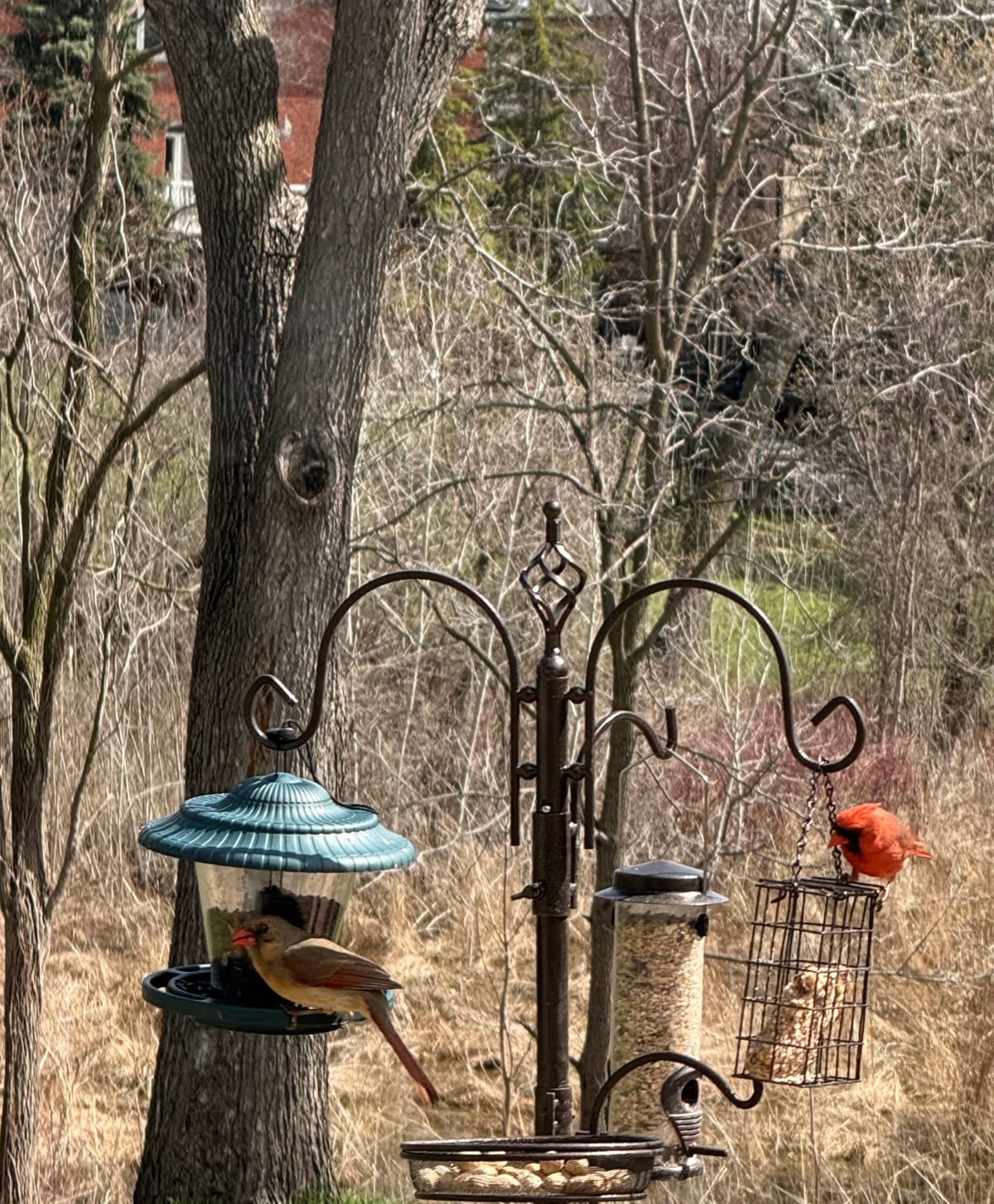
A feeder hanging in a tree
Rule one is already gone and no amount of repositioning recovers it. The defense shifts to the feeder's own design: cages, weight-activated ports, or a baffle above each feeder. That is a legitimate choice, not a failure, but it should be a choice you made rather than one that happened.
A feeder at the window
Get it genuinely close. A foot or two, per the Cornell Lab. A window feeder mounted on the glass and a feeder on a pole four feet from the same window sit on opposite sides of the risk, despite looking like variations on one idea.
If a bird has already hit the glass, placement is the second problem. The first is the bird on the ground, and there is a test that tells you within seconds whether it is dead or only stunned: what to do in the hour after a bird hits your window.
A yard with squirrels
Clearance alone does not finish the job. A metal baffle four to five feet up the pole is the other half, and the two measurements only work as a system.
One behavior at the glass has nothing to do with placement at all. A bird that attacks the same window repeatedly without injuring itself is defending a territory against its own reflection, and moving the feeder will not touch it.
Questions people ask
How far should a bird feeder be from a tree? About ten feet, per Project FeederWatch, which is also the distance it recommends as a compromise between keeping squirrels off and keeping birds near cover.
How far should a bird feeder be from a window? Close, if it is going to be near one at all. Audubon says feeders closer than three feet prevent birds from building enough momentum to injure themselves, and the Cornell Lab says a foot or two. The experiment behind that advice recorded no fatalities at all within one meter. If the feeder cannot be that close, move it away from the windows where strikes actually happen, while knowing that the popular "30 feet" threshold sits past the end of the tested data.
Is it bad to hang a feeder in a tree? It gives up the squirrel clearance rule completely, so the protection has to come from the feeder's own design instead. Plenty of people feed successfully from trees. They just do it with cages and baffles rather than distance.
Where should you not put a bird feeder? In the band outside a window that is far enough for a startled bird to reach full speed and close enough to still hit the glass. Also anywhere a cat can reach or ambush from, which is the same jump-off logic as squirrels with worse consequences.
Does feeder placement really matter for window strikes? Over a billion birds a year die from glass collisions in the United States, and a feeder decides how many birds are flying near your particular windows, and how often they are startled into flight. Placement is the variable you control.
Where to put a bird feeder: the short version
Where to put a bird feeder is a question with three answers that disagree. Ten feet of clearance from launch points protects against squirrels and cats. Nearby cover is what makes birds willing to use the feeder at all, and Project FeederWatch settles those two at about ten feet as an explicit compromise. Bird window collisions and feeder placement are the third constraint and the most serious, and the fix runs the opposite direction from instinct: closer is safer, because a bird that has not accelerated cannot hurt itself. That half of the rule was measured, with zero fatalities recorded within a meter of the window. The familiar "or 30 feet away" half was not, and sits just past where the measurements stop.
No spot satisfies all three. Pick which one you are breaking, and then defend that side deliberately, whether with a baffle or a window mount or a caged feeder. Where to put a bird feeder is a choice between three things you cannot have at once.
The photographs in this article were taken by our contributors, yuanyuan and Kevin Hu, and are used with permission. More on where our photographs come from.