
Why Won't Birds Use My Birdhouse? Usually the Habitat, the Height, or the Wait
Why won't birds use my birdhouse? Usually wrong habitat, wrong height, or not up long enough. What the placement guidance actually specifies.
If you are asking why won't birds use my birdhouse, the answer is usually one of three things: the habitat around it does not suit any cavity nester in your area, it is at the wrong height, or it has not been up long enough.
The box itself is rarely the problem, and one empty season is not evidence of anything.
How long until birds use a new birdhouse?
Longer than most people wait. NestWatch, the Cornell Lab's nest box program, opens its placement guidance by heading that off: Don't be discouraged if birds don't begin nesting in them immediately; sometimes it takes time for the birds to discover them.
There is no published number of seasons, and we are not going to invent one. What the guidance implies is that a box put up in April, in a yard with no cavity nesters currently prospecting, has missed that year rather than failed.
So before changing anything, check the calendar. If the box went up after the breeding season started, the diagnosis is timing and everything below can wait until next year.
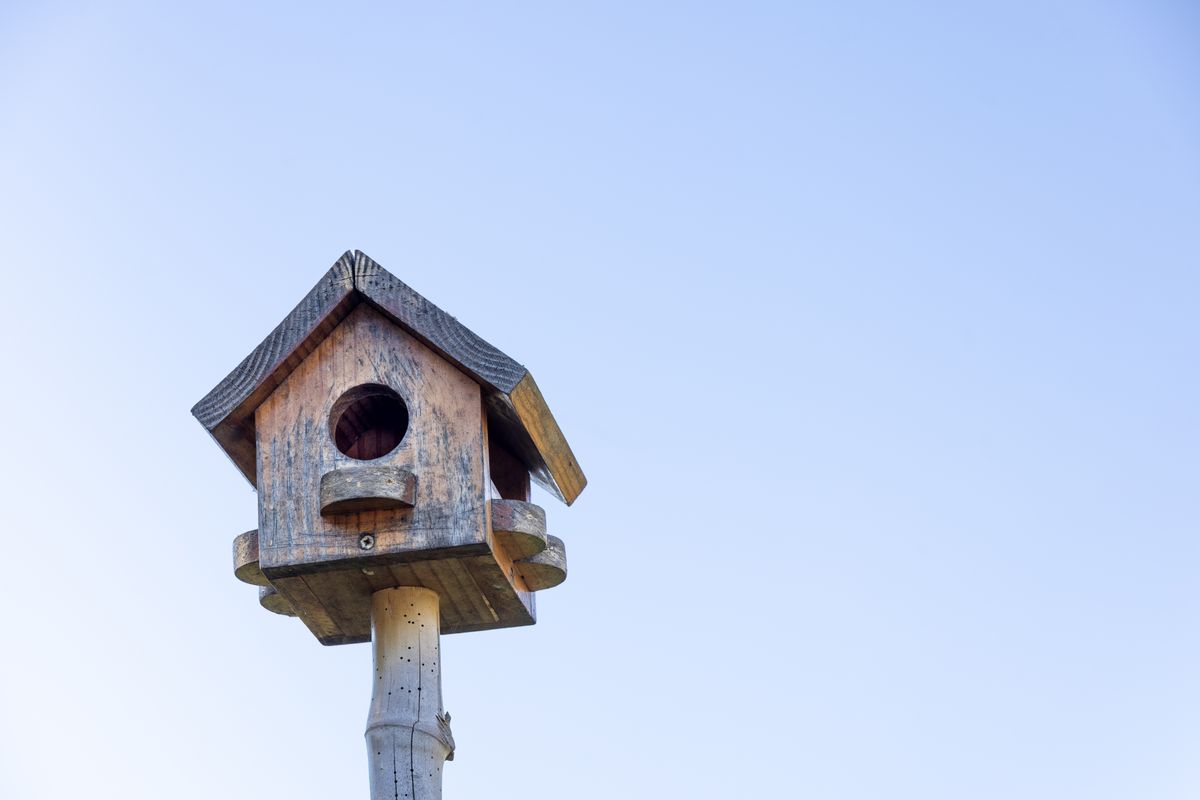
Where to put a birdhouse: the habitat picks the species
This is the failure people least expect, because it has nothing to do with the box.
NestWatch states it plainly: Because different species of birds prefer different kinds of nesting habitat, the vegetation surrounding your box will play a role in determining which species will nest in it. Their summary of the whole problem is four words: Remember: right box, right place.
The University of New Hampshire Extension puts the same rule in terms of outcomes: The habitat type near the birdhouse will determine which species might use it, and then gives the pairings: birdhouses that are placed near water are more likely to attract tree swallows, whereas house wrens will use those in gardens. Eastern bluebirds prefer to nest on the edge of open fields, while chickadees like wooded areas.
The consequence is uncomfortable and worth stating directly. A bluebird box in a wooded yard is not a bluebird box. NestWatch is specific that nest boxes for bluebirds should be placed in open habitat, and no amount of correct construction substitutes for that.
One thing to rule out while you are looking around: NestWatch notes that yards and gardens are potentially good sites, but avoid areas where pesticides and herbicides are used.
How high should a birdhouse be?
Five feet at minimum for most species, and the useful range is per species rather than universal.
UNH gives the floor: For most species, bird houses should be at least five feet above the ground, if not higher.
NestWatch's own species table is more specific, and the ranges do not all overlap. Eastern Bluebird is listed at 3 to 6 feet. White-breasted Nuthatch at 5 to 20 feet. Purple Martin at 10 to 15 feet. Barn Owl at 8 to 25 feet. A box at six feet is right for a bluebird and low for a nuthatch.
How far apart should birdhouses be?
At least 25 feet as a general rule, and per species the real figure ranges from 10 feet to over a thousand.
UNH gives the general version and the reason: Try to space birdhouses at least 25' apart, because some species are territorial and will not allow other birds to nest too close by.
The per-species numbers are where this gets interesting, and almost nobody reproduces them. From NestWatch's table: Black-capped Chickadee is listed at 650 feet, and Carolina Chickadee at 30 feet. Two chickadees, and a twenty-fold difference in how much room each wants. White-breasted Nuthatch is listed at 1,040 feet. Purple Martin, which nests colonially, is listed at 10.
If your yard holds several boxes and none of them are occupied, crowding is a live hypothesis, and it is not answered by a single number.
There is an exception worth knowing, because it goes the other way. NestWatch describes deliberately pairing boxes for species that tolerate each other: This involves placing boxes in pairs on poles 15 to 25 feet apart, which suits Tree Swallows and bluebirds because they will nest near each other while driving off their own kind.
Nest box placement by species
Ten of the 29 species in NestWatch's placement table, transcribed cell by cell. The last column is the source's own minimum spacing, and for some species it is not a distance at all: the full table gives Brown-headed Nuthatch as one box per 6 acres and American Kestrel as half a mile.
| Species | Habitat it wants | Height | Entrance hole | Minimum spacing |
|---|---|---|---|---|
| Eastern Bluebird | Open field or lawn, orchards, scattered trees | 3 to 6 ft | 1 1/2" round, or 2 1/4" x 1 3/8" oval | 300 ft |
| Carolina Wren | Forest with thick underbrush, gardens, backyards | 3 to 6 ft | 1 1/2" round, or 2 1/2" x 5" slot | 330 ft |
| House Wren | Farmland, open forest, gardens, backyards | 5 to 10 ft | 1" round | 100 ft |
| Black-capped Chickadee | Woodlots and yards with mature hardwoods | 5 to 15 ft | 1 1/8" round | 650 ft |
| Carolina Chickadee | The same habitat description | 4 to 15 ft | 1 1/8" round | 30 ft |
| Tufted Titmouse | Deciduous forest, woodlots, forest edges | 5 to 15 ft | 1 1/4" round | 580 ft |
| White-breasted Nuthatch | Deciduous woodland near open areas | 5 to 20 ft | 1 1/4" round | 1,040 ft |
| Prothonotary Warbler | Lowland hardwood, over or near water | 4 to 12 ft | 1 1/4" round | 235 ft |
| Purple Martin | Broad open areas, unobstructed | 10 to 15 ft | 2 1/8" round, or crescent | 10 ft |
| Barn Owl | Open fields and marshes near structures | 8 to 25 ft | 3 3/4" x 4 1/2" elliptical | 100 ft |
Read the spacing column top to bottom. Across these ten it spans two orders of magnitude, and across the full table it is wider still, since American Kestrel is listed at half a mile. That range is the strongest argument against any single piece of birdhouse advice being right for your yard.
Which way should the hole face?
Away from the prevailing wind for most species, and toward what the bird wants to look at for some.
NestWatch attaches facing notes to individual species rather than issuing one rule. For chickadees, titmice, and nuthatches the note is that the hole should face away from prevailing wind. For Eastern Bluebird it is more particular: the entrance hole should face open field, preferring east, north, south, and then west-facing directions.
That bluebird ordering is worth noticing, because it ranks four options rather than naming one. West is last, not forbidden.
Pole or tree?
Pole, and the reason is predators rather than the birds' preference.
This is the same logic that governs feeders, and the same hardware. A box on a tree limb is reachable by everything that lives in the tree, and a smooth metal pole with a baffle on it is not. The baffle dimensions that actually work, including the length a raccoon needs rather than the height a squirrel needs, are in what a squirrel baffle does not stop.
Purple Martins have a stricter version of the same requirement. NestWatch specifies that there should be no trees or buildings within 40 feet of the martin pole in any direction.
When to put up a birdhouse
Before the breeding season, which means winter rather than spring.
NestWatch gives regional dates: In the south, place your nest boxes by February. In northern regions, place your nest boxes by mid to late March.
UNH agrees on the principle: Make sure to get your birdhouses up as soon as possible in the spring, well before the start of the breeding season, naming mid to late March as ideal.
A box that goes up in May is a box for next year. That is not a wasted purchase, and there is a use for it over the winter: a nest box can be converted into a roost box for the cold months.
Is last year's nest still inside?
If it is, that alone may be the answer.
The timing of that cleanout is genuinely contested, with two state programs reaching opposite conclusions on whether it reduces parasites, and the evidence is laid out in when to clean out a nest box. What is not contested is that a box packed with last year's material is a box with no room in it.
Why won't birds use my birdhouse: what is probably not the problem
Three things get blamed and rarely deserve it. Each has its own article, so this is a short list rather than a fourth section.
The hole size, unless it is too big. Hole diameter decides who is excluded rather than who is attracted, and the thresholds are specific: what a nest box entrance hole can and cannot exclude.
The perch, if it has one. A perch does not stop native birds using a box. It helps the species you do not want, which is why the recommendation is to leave it off, and that is covered in the same article.
The lack of nesting material. Birds bring their own. What you put out is a separate question with a real safety dimension, in nesting materials for birds.
Questions people ask
Why won't birds use my birdhouse? Most often the surrounding habitat does not suit a cavity nester in your area, the box is at the wrong height, or it has not been up long enough. NestWatch says explicitly that birds may take time to discover a new box.
How long does it take for birds to find a new birdhouse? There is no published figure. NestWatch advises not being discouraged by an immediate lack of nesting, and a box installed after the season began has missed that year rather than failed.
Where should I put a birdhouse? Where the habitat matches the species you hope for. Open ground for bluebirds, gardens for house wrens, wooded yards for chickadees, near water for tree swallows.
How high should a birdhouse be? At least five feet for most species per UNH Extension. NestWatch's per-species ranges run from 3 to 6 feet for Eastern Bluebird up to 8 to 25 feet for Barn Owl.
How far apart should birdhouses be? At least 25 feet in general. NestWatch's per-species figures range from 10 feet for colonial Purple Martins to 1,040 feet for White-breasted Nuthatch.
Should a birdhouse face a particular direction? For several species NestWatch says the hole should face away from prevailing wind. For Eastern Bluebird it recommends facing an open field, preferring east, then north, then south, then west.
Is it better on a pole or a tree? A pole. UNH advises against hanging boxes from trees or buildings, because a metal pole can carry a predator baffle and a branch cannot.
Why won't birds use my birdhouse: the short version
Start with the calendar, then the map, then the tape measure. A box hung after nesting began has simply missed the year. A box in the wrong habitat will keep missing every year, however well it is built, because habitat is what decides which cavity nesters are even looking.
After that it is height and spacing, and both are species-specific to a degree the general advice hides. The gap between a Carolina Chickadee wanting 30 feet of separation and a White-breasted Nuthatch wanting 1,040 is not a rounding difference, and it is the reason a yard with four boxes may hold one nest.
So go and stand at the box and look outward rather than at it. What is growing within a hundred feet decides who is shopping, and everything you can change about the box itself only matters after that. Why won't birds use my birdhouse is answered in the hundred feet around it more often than in the box.
This article contains no affiliate links. Placement figures are transcribed from the sources linked above and apply to North American species.