
What Nesting Materials Are Safe for Birds? (The Advice Has Changed)
Nesting materials for birds: yarn, dryer lint and pet hair should not go out. What changed, what a 2025 study found in 103 nests, and what to offer instead.
Yarn, dryer lint, and pet hair are the three nesting materials for birds most often put out, and none of them should be. That is not an old rule that everyone has forgotten. It is a change in the advice, and the pet hair part rests on research published in 2025.
If you have a bag of scrap wool set aside for spring, this is the article that asks you not to use it.
Can you put out yarn for birds?
No, and NestWatch is explicit that this reverses what used to be recommended: While common advice used to say that yarn was safe to put out for birds, we now know that advice is outdated.
Two problems, and the fiber content is only the first: Yarns are not always made of natural materials (e.g., acrylic or nylon), and even wool and cotton skeins may be treated with chemicals or dyes that can harm the delicate skin of nestlings.
So buying natural-fiber yarn does not solve it. The dye and treatment travel with the wool.
What does string actually do to a nestling?
It wraps, and then the bird grows into it.
NestWatch describes the mechanism: Stringy materials are also harmful because they can potentially wrap around the feet, wings, or neck of nestlings, either trapping the bird in the nest (preventing fledging) or restricting airflow.
The US Fish and Wildlife Service states the outcome without softening it: String, twine and yarn can get wrapped around the legs and necks of birds and nestlings, cutting off circulation and often resulting in death.
Audubon adds the detail that makes it worse than a snapshot suggests, since a loop that fits a hatchling does not fit the same bird a week later: Yarn in a nest can get caught around a baby bird and cut off circulation as it grows.
There is a second hazard that has nothing to do with entanglement: Hair, string, and yarn can also be choking hazards if mistaken for food.
Why pet hair is the one that surprises people
Because the problem is what is on the hair, and there is now a number attached to it.
A 2025 study from the University of Sussex, published in Science of the Total Environment and funded by SongBird Survival, tested the fur lining real nests. The researchers describe the practice they set out to examine, which is the exact thing being recommended in craft and gardening content every spring: pet owners leave brushed-out fur outdoors hoping birds will use it, and While this practice may seem harmless and even helpful, our study has found that chemicals commonly used in animal flea and tick treatments (e.g., fipronil, imidacloprid, permethrin) make their way into bird's nests.
The team examined 103 nests submitted by volunteers through the British Trust for Ornithology's Nesting Neighbour Scheme, and detected 17 of the 20 insecticides they screened for. The headline result: This included fipronil present in 100% of nests and imidacloprid present in 89% of nests.
Detection alone would be a weaker finding. This one goes further: We also found a relationship between the concentration detected in fur and the birds' breeding success, with a higher egg and chick mortality in nests with a higher concentration of insecticides detected.
One more fact from the same summary explains how ordinary this contamination is. These are not exotic compounds: These can commonly be found in shampoos, sprays, and spot-on treatments for pets and/or livestock. And several of them are often banned for agricultural use due to their environmental risks while remaining in normal veterinary use.
The FWS reaches the same practical conclusion by a shorter route: Pet hair may also be dangerous due to chemicals from flea treatments and shampoos.
The study was conducted in the UK on blue tits and great tits. The products are sold on both sides of the Atlantic, and the mechanism does not depend on the species, but it is a UK dataset and worth describing as one.
Human hair in bird nests: the danger is length
Same problem as yarn, with a threshold: Hair from humans that is longer than one inch poses the same risk as yarn and string.
An inch is short. Anything you would recognize as a hair from a brush is over that line.
What about dryer lint?
Two independent reasons, and they fail in different directions.
NestWatch on the chemistry: Another very popular idea is using dryer lint, but lint should never be provided for birds to use. The chemicals in detergents and the microplastics that may accumulate from synthetic fabric can be harmful.
Audubon on the physics: dryer lint quickly loses its fluffiness and structure when wet. Dryer lint is unsustainable in the rain, crumbling and leaving holes in an otherwise solid nest.
So even a chemical-free version would still be the wrong material. Lint looks like insulation and behaves like tissue paper.
"But I have seen a bird use it"
You probably have, and NestWatch answers this directly rather than dodging it: while you may have seen a bird using some in its nest before, it doesn't always mean those items are safe.
Birds collect what is available. A bird using something is evidence that it was within reach, and the 2025 fur study is the clearest illustration of the gap: those nests were built successfully, looked normal, and were carrying insecticide the whole time.
What should go out instead?
Things the birds would have found anyway.
Poultry feathers are allowed with the same caveat, since NestWatch notes that if you keep chickens their feathers may be used by swallows, wrens, or flycatchers, provided the feathers have had no chemical treatments applied.
Swallows and wrens are cavity nesters, which means the material question sits alongside the box itself. What that box needs is an entrance hole sized to admit them and exclude the competition.
Matching the material to your local birds is a nice touch rather than a requirement: Chickadee and phoebe nests, for example, are easily identifiable because they incorporate lots of bright green moss. Bluebirds and robins, on the other hand, make nests out of grasses and straw.
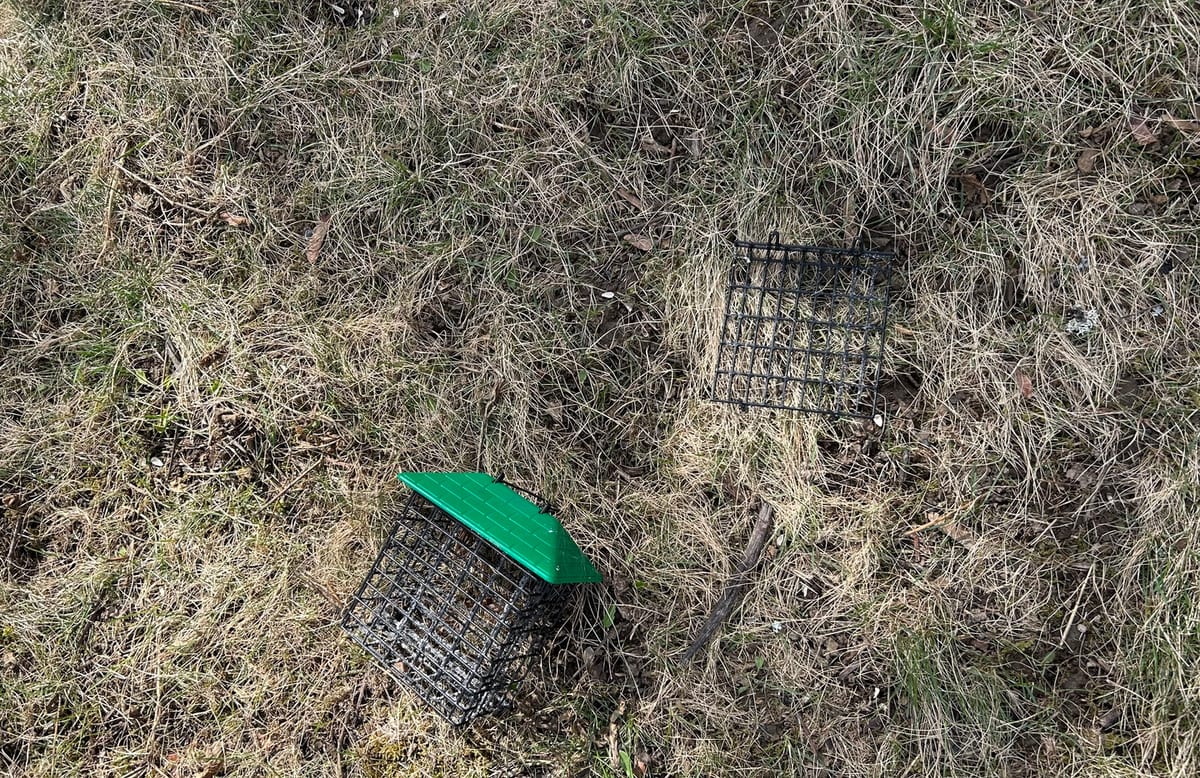
On presentation and upkeep: You can gather these items and place them in an empty, clean suet cage, or simply provide them in piles in your yard or on a deck railing. Be sure to refresh the offerings after rain, or if you notice any mold or mildew growing on them.
That last clause matters. Nesting material left out through a wet spring becomes the same mold problem as seed left in a feeder.
Nesting materials for birds: what to put out and what to keep out
| Material | Verdict | Why |
|---|---|---|
| Yarn, string, twine | No | Wraps around legs and necks; dyes and treatments; choking risk |
| Dryer lint | No | Detergent chemicals and microplastics; crumbles when wet |
| Pet and livestock hair | No | Flea and tick insecticides, found in 100% of nests in one 2025 study |
| Human hair over one inch | No | Same entanglement risk as string |
| Moss, twigs, leaves, lichen, rootlets | Yes | What the birds use anyway |
| Untreated grass clippings | Yes | Only if no fertilizer or pesticide has been applied |
| Poultry feathers | Yes, with care | Only if chemically untreated |
Do they even need your help?
No, and both sources say so plainly, which is a useful thing to hear before spring.
The FWS: It's important to remember that birds are well adapted and get by just fine without human intervention. NestWatch lands in the same place: Birds don't need help from humans finding nesting materials, but if you do provide them, it's best to go natural.
This is the same shape as the food side of the same question, where the things people most want to offer are the ones to leave indoors. The feeder is a supplement, the nest box is an option, and the nesting material is a courtesy. None of it is a lifeline, which is exactly why the downside of doing it badly outweighs the upside of doing it at all.
None of this attracts a nesting pair on its own. Whether birds consider your box at all is decided by habitat, height, and how far it sits from the next box. And the same restraint applies once a pair does move in: a nest that has gone quiet is almost always being incubated rather than abandoned.
Questions people ask
Can you put yarn out for birds? No. NestWatch states that the old advice recommending yarn is outdated. Yarn may be synthetic or chemically treated, and stringy material can wrap around a nestling's feet, wings, or neck.
Is dryer lint safe for bird nests? No. NestWatch cites detergent chemicals and microplastics from synthetic fabric. Audubon adds that lint loses its structure when wet and crumbles, leaving holes in the nest.
Can birds use pet hair for nests? It should not be offered. A 2025 University of Sussex study found fipronil in 100% of 103 nests tested and imidacloprid in 89%, with higher insecticide concentrations linked to higher egg and chick mortality.
Is human hair dangerous for birds? Hair longer than one inch carries the same entanglement risk as yarn and string, per NestWatch.
What nesting material can I put out for birds? Moss, twigs, leaves, lichen, rootlets, and untreated grass clippings. Poultry feathers are acceptable if no chemical treatments have been applied.
Where should I put nesting material? In an empty, clean suet cage, or in piles in the yard or on a deck railing. Refresh it after rain or at any sign of mold.
Nesting materials for birds: the short version
The three things people reach for first are the three to leave indoors. Yarn and string entangle and carry dye. Lint carries detergent and falls apart wet. Pet hair carries flea treatment, and the 2025 study that looked for it found fipronil in every nest it tested.
What is safe is what was already outside: moss, twigs, leaves, lichen, rootlets, and grass clippings from a lawn nobody has sprayed.
Which points at the easiest version of helping. Leave a corner of the garden untidy through autumn and spring, and the material is there without a suet cage, a decision, or a risk. The best nesting materials for birds are the ones you did not tidy away.
The photograph in this article was taken by our contributor Kevin Hu and is used with permission. More on where our photographs come from.