
Nest Box Entrance Hole Size: What It Keeps Out, and What It Cannot
Nest box entrance hole size can exclude European Starlings but not House Sparrows. The two thresholds, and why 1.5 and 1 9/16 inches are not the same.
Nest box entrance hole size is a filter, and it is worth knowing exactly what it filters. It can exclude European Starlings. It cannot exclude House Sparrows, because every hole a bluebird can use is already wider than a House Sparrow needs.
That single fact reorganizes the whole subject. One invasive competitor is a carpentry problem, and the other one never was.
What does the entrance hole actually control?
Access, in both directions. NestWatch puts the principle simply: By providing a properly sized entrance hole, you can attract desirable species to your birdhouses while excluding predators and unwanted occupants.
Two numbers do most of the work, and NestWatch states both as thresholds rather than recommendations.
On House Sparrows: Don't want to give a home to House Sparrows? 1 1/4" is the smallest hole size they can fit into, so select a smaller hole size.
Hold on to those two figures. Everything below is a consequence of them.
What size hole for a bluebird house?
The North American Bluebird Society gives the specifications, and they differ by species.
Its general position: For all three species of bluebirds, a 1 9/16 inch round hole is acceptable.
Then the detail. For the eastern species there is a choice of three shapes: For Eastern Bluebirds, you can use a 1½ inch round hole, a 1⅜ x 2¼ inch vertical oval hole, or 1⅛ inch horizontal slot entrance.
For the western species there is less room to move: Western and Mountain Bluebirds prefer a 1 9/16 inch round opening or 1 3/16 inch slot entrance.
And where you might get either bird, NABS resolves it in favor of access: Where the ranges of the species overlap, use the larger opening.
Why 1½ inches and 1 9/16 inches are not interchangeable
Those two sizes are a sixteenth of an inch apart, and the starling threshold is the larger of the two.
NABS heads its entrance-hole section "ENTRY HOLE to keep predators and European starlings out", and within that section it says a 1 9/16 inch hole is acceptable for all three bluebirds. NestWatch says 1 9/16" is the smallest hole a European Starling can fit into. So the size offered under a starling-exclusion heading sits exactly at the size where starling exclusion stops working.
Both sources are stating something true. NABS is answering "what will bluebirds use," and its list is generous because Western and Mountain Bluebirds want the larger opening. NestWatch is answering "what will keep a starling out." The two questions have different answers, and only one of them is in the section heading.
The practical reading splits by species:
If you have Eastern Bluebirds, you have a genuine choice, and 1½ inches is the one that sits below the starling threshold. Take it. The sixteenth of an inch you give up costs you nothing.
The same two measurements turn up away from the nest box. NABS recommends a hopper mealworm feeder with a 1½ inch or 1 9/16 inch hole at each end for the same reason, which is that the hole is doing the excluding there too.
If you have Western or Mountain Bluebirds, the size they prefer is the size starlings can pass. Hole diameter is not going to solve starlings for you, and the answer has to come from somewhere else, such as the slot entrance NABS lists as the alternative.
Can hole size keep House Sparrows out?
No, and the arithmetic is short.
House Sparrows fit through anything 1 1/4" or larger. The smallest hole on the bluebird list is 1½ inches. Every round opening a bluebird will use is wider than the sparrow threshold, with no overlap to exploit and nothing to tune.
This matters because "get the hole size right" is repeated as though it settles competitor problems generally. It settles one of them. House Sparrow management is a separate job that hole diameter cannot do, and anyone selling you a box on the promise that its dimensions keep sparrows out is describing something the numbers do not support.
Which competitors can you legally remove?
This part is not about carpentry. Federal law treats these three birds differently.
NestWatch states the position: Unlike the House Sparrow and European Starling, House Wrens are protected by the Migratory Bird Treaty Act. You may not legally remove nesting material, eggs, nestlings, or adult House Wrens from a nest box.
The same split decides what you may do about a flock at a feeder, and the same competition for cavities is named among the reasons one woodpecker has declined. So the three species people most often want out of a box fall into two legal categories. House Sparrows and European Starlings are non-native and unprotected. House Wrens are native, protected, and competitive, which is an uncomfortable combination if one takes over your box, and the lawful response is to wait until the season ends and move the box.
That sits on top of any local rules. Federal protection is a different layer from the municipal ordinances that govern feeding, and both can apply in the same yard.
Should a nest box have a perch?
No, and the reason connects directly to the sparrow problem above.
NABS is unambiguous: Perches should never be used on any bluebird nestboxes, because they are not needed, and they facilitate harassment by non-native House Sparrows.
NestWatch lists "No outside perches" among the features of a good birdhouse for the same reason. Cavity nesters do not need somewhere to stand outside the hole. What a perch adds is a convenient position for a competitor to sit and harass whatever is inside.
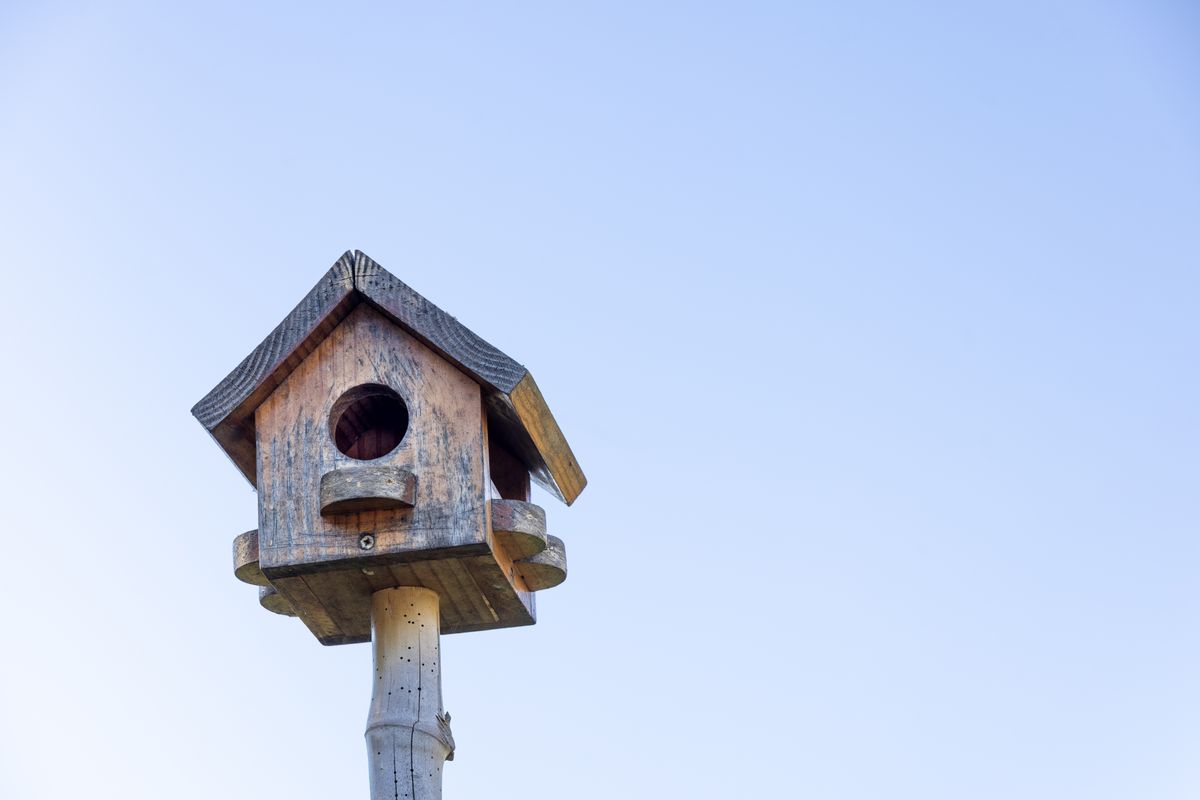
This is worth checking before you buy, because decorative birdhouses very often have one. A dowel under the hole is the quickest way to tell that a box was designed to look like a birdhouse instead of working as one.
Bird house hole size chart
| Size | Who it admits | Who it excludes | Source |
|---|---|---|---|
| 1 1/4" | House Sparrow and anything smaller-bodied | Starlings, and birds needing a wider hole | NestWatch threshold |
| 1½" round | Eastern Bluebird | European Starling | NABS spec, NestWatch threshold |
| 1⅜ x 2¼" vertical oval | Eastern Bluebird | Listed by NABS under starling exclusion | NABS spec |
| 1⅛" horizontal slot | Eastern Bluebird | Starling and House Sparrow | NABS spec |
| 1 3/16" slot | Western and Mountain Bluebird | Starling and House Sparrow | NABS spec |
| 1 9/16" round | All three bluebirds | Nothing on this list | NABS spec, at NestWatch's starling threshold |
Note what the two slot entries do. Both slot sizes fall below the 1 1/4" House Sparrow threshold while still being listed by NABS as usable by bluebirds, which is the only line in this table that excludes both invasive competitors at once. We have not found a source testing how bluebird occupancy compares between slots and round holes, so this is a spec observation and not a recommendation.
What else nest box entrance hole size depends on
It can get bigger without your permission. NABS: If the hole is enlarged (e.g., by woodpeckers or squirrels), replace that part of the box, or put a metal or wooden hole guard over the enlarged hole. A box that started at 1½ inches and has been worked on by a squirrel is no longer excluding anything, which is the same gnawing problem that ruins feeders.
Which way it faces. NABS: Mount the box so the entry faces east or south to prevent afternoon overheating, and away from prevailing winds so rain and snow stay out.
What it is mounted on. NABS advises against tree trunks, since Mounting on tree trunks is not recommended because it makes the nestbox too accessible to climbing predators. A smooth pole with a baffle is the standard answer, and it is the same hardware discussed in the autumn nest box article.
Getting the box right is one half of helping cavity nesters. The other half is not undoing it with the wrong nesting material.
One thing to know before buying. NABS states that it no longer approves specific nestbox designs, and warns that boxes have been sold carrying a "NABS approved" logo while not conforming to its recommendations. The logo is not a specification. The measurements are.
What this article does not cover
Hole sizes for chickadees, wrens, Tree Swallows, and woodpeckers are widely published, and we have not included them because we could not trace them to a primary specification we can link. NestWatch's per-species tool renders its figures inside an interactive component rather than in the page text, and its species pages carry nesting biology instead of box dimensions.
Copying numbers from secondary pages and presenting them as sourced would be worse than a short table, so the table above stops where the sourcing stops. If we locate a citable specification covering more species, this article gets extended.
And if the box is correctly built and still empty, the hole is not the place to look. An unused box is usually a placement problem, and habitat, height, and spacing decide it.
Questions people ask
What size hole should a bluebird box have? For Eastern Bluebirds, a 1½ inch round hole, a 1⅜ by 2¼ inch vertical oval, or a 1⅛ inch horizontal slot. Western and Mountain Bluebirds prefer a 1 9/16 inch round opening or a 1 3/16 inch slot, per the North American Bluebird Society.
How do you keep starlings out of a bluebird box? Use a hole smaller than 1 9/16 inches, which NestWatch gives as the smallest size a European Starling can pass. For Eastern Bluebirds a 1½ inch hole does this. Western and Mountain Bluebird boxes prefer the larger opening, so exclusion has to come from elsewhere.
How do you keep House Sparrows out of a nest box? Not by hole size. House Sparrows fit through anything 1 1/4 inches or wider, and every round bluebird opening is wider than that.
Should a birdhouse have a perch? No. NABS states that perches should never be used on bluebird nest boxes because they are unnecessary and make it easier for House Sparrows to harass the occupants.
Can I remove a House Wren nest from my box? No. NestWatch states that House Wrens are protected by the Migratory Bird Treaty Act, so their nesting material, eggs, nestlings, and adults may not legally be removed. House Sparrows and European Starlings are not protected.
Which way should a nest box face? East or south, according to NABS, to prevent afternoon overheating, and away from prevailing winds.
Nest box entrance hole size: the short version
Two numbers decide most of it. Starlings need 1 9/16 inches and House Sparrows need 1 1/4, so a hole can be cut to shut out the first and never the second.
For Eastern Bluebirds that makes the choice easy: 1½ inches rather than 1 9/16, since both work for the bird and only one works against the starling. For Western and Mountain Bluebirds the preferred opening sits at the starling line, and the slot entrance is the only listed option that clears both invasive species.
So go and measure the box you already own. A lot of what is sold comes at 1 9/16 inches, and if there is a dowel under the hole as well, you are looking at a box built for the shelf rather than for the bird. Nest box entrance hole size is the one specification that cannot be corrected after the season starts.
The photograph in this article is a stock image, credited above. The rest of the site's photographs come from two named contributors. More on where our photographs come from.