
Bird Seed Sprouting: What Grows Under a Feeder, and What Does Not
Bird seed sprouting under a feeder comes down to which seeds are still alive. How to keep it from sprouting, and the bare-ground claim nobody sources.
Bird seed sprouting under a feeder happens for an unremarkable reason: most of what you buy is whole, living seed, and seed that lands on damp ground does what seed does. The question worth asking is not why it grows but which parts of the bag can grow, because that is the part you control at the store.
The ground under a feeder also does the opposite thing. Some of it goes bare and stays bare, and the explanation for that is repeated far more confidently than it is sourced.
Why is my bird seed sprouting?
Because a sunflower seed in its shell is not a snack. It is a seed, in the botanical sense, with an embryo inside it and nothing wrong with it.
Everything that misses a bird's beak lands in a spot that is often better for germination than a garden bed: bare soil, regular foot traffic to work seed into it, and the shade of the feeder overhead holding moisture. The Lady Bird Johnson Wildflower Center describes the result in passing, while answering a question about something else entirely: certainly sunflowers will freely sprout everywhere, often with the help of birds, who are no doubt delighted that you are contributing to their diet.
So the sprouting is not a defect in the seed or a sign you bought something odd. It is the normal behavior of viable seed that ended up on soil.
What you can change is how much of the bag is viable in the first place.
What is sprouting under my bird feeder?
Look at what you are pouring in, because each part of a mix behaves differently once it hits the ground.
| What is in the bag | Whole seed with an embryo? | What comes up |
|---|---|---|
| Black-oil sunflower, in shell | Yes | Sunflower seedlings, the broad-leaved ones |
| White proso millet | Yes | Fine grass-like blades, the most common surprise |
| Milo and wheat | Yes | Coarse grass, taller and thicker than lawn |
| Cracked corn | Broken by processing | Little, since cracking damages the kernel |
| Hulled sunflower | Shell removed | Uncertain, see below |
| Nyjer | Heat-treated before import | Nothing |
The grass-shaped one is the one that confuses people, because it does not look like anything they bought. Millet and milo are grains, and a grain seedling is a blade of grass. That is the answer to why is grass growing under my bird feeder in most yards. The cheap fraction of the mix is coming up, and it comes up in the shape of a lawn.
Which is a second argument against the cheap fraction, on top of the one about what filler costs you per pound of seed actually eaten. Milo and wheat are the ingredients most likely to be present in volume and least likely to be eaten, so they are the ones with the best chance of reaching the soil intact.
Does nyjer seed sprout?
No, and nyjer is the one item on the list with a settled answer.
Project FeederWatch states the reason in a single line: Seeds are heat-treated prior to importation to prevent sprouting. Nyjer is imported, and the treatment is a condition of importing it.
That is worth knowing for two separate reasons. If you feed goldfinches from a small-port feeder, the spill under it is inert and will never become a weed problem. And if something is coming up under a nyjer feeder, it did not come from the nyjer, which points you at whatever else is nearby.
The name confusion that surrounds this seed is covered where the ten common feeder foods are compared, including why calling it thistle is wrong.
How to keep bird seed from sprouting: buy seed that cannot
Two options, and only one of them is fully settled.
Nyjer is settled. Heat-treated, inert, and useless to anything but small finches. It solves sprouting by being a specialist food rather than a staple.
Hulled sunflower is the practical answer, with a hedge on it. Sunflower hearts are sold as no-mess seed, and Project FeederWatch confirms the mess part directly: Often referred to as "no mess" sunflower, the lack of hulls does indeed reduce the chaff underneath feeders.
On whether the kernel itself can still grow, the most careful source we found does not commit. The University of Maryland Extension's Home and Garden Information Center, answering a reader whose birdseed sunflower failed to come up when planted deliberately, offers this: Hulling would probably interfere with germination since it's a protective seed coat. The word doing the work there is probably, and we are not going to upgrade it.
The same exchange is a useful caution against assuming any bag behaves predictably. That reader's whole-shell birdseed sunflower produced no seedlings at all, and the extension answer worked through irradiation, seed age, rot and weather without landing on a cause: Unfortunately, germination failures like this aren't unheard of, though we don't always know the reason. Their suggestion was to stop guessing and measure: If you have any of that batch of seeds remaining, you can perform a germination test. A dozen seeds on a damp paper towel in a bag answers for your bag what no article can.
The cost of switching is real and it is not only money. FeederWatch attaches a storage condition to hulled seed: Be sure to keep the seed dry because it tends to spoil more quickly than sunflower in the shell. You are trading a sprouting problem for a spoilage problem, and the second one has to be managed at the feeder rather than at the store.
The other direction: when the ground goes bare instead
Some yards have the opposite complaint. Nothing grows under the feeder at all, the grass thins out and gives up, and searching for bird seed killing grass returns the same explanation everywhere: sunflower hulls are allelopathic, meaning they release chemicals that suppress other plants.
That explanation is stated by real institutions. Illinois Extension puts it plainly: Another interesting fact about sunflowers is that their hulls have a toxin that prevents the growth of other plants, and connects it to exactly this observation: You might have noticed that soil is often bare under birdfeeders where sunflower hulls accumulate on the ground. An extension Master Gardener answering a Minnesota reader with 200 pounds of shells under the feeders was equally direct: All sunflower shells contain allelopathic toxins that prevent other seeds from germinating.
Neither answer cites anything. A third reader took the question to Ask Extension specifically because they could not verify it, saying so in the question itself: I can't find a source that looks very trustworthy. The reply confirmed the claim, again without a citation.
Searching the life-sciences literature for work on sunflower hulls returns studies on sunflower plant residue and extracts in agricultural fields, not on hulls at the depth they reach under a feeder. And Project FeederWatch, which publishes a page devoted to hulled versus in-shell sunflower and mentions chaff accumulating underneath, does not raise allelopathy at all.
Meanwhile the most careful source names a second mechanism that needs no chemistry. The Wildflower Center hedges the first one, Sunflower seed may be allelopathic in some situations, and then points at the physical reality: The discarded seeds and hulls can build up to quite a depth if you are a devoted feeder of wildlife, and will certainly smother just about anything that tries to come up.
A layer of shells deep enough to smother seedlings is a mulch. Mulch suppresses growth by blocking light, and it does so whether or not anything is dissolved in it. Add the traffic of birds and squirrels working the same square yard every day, and there are three candidate explanations for a bare patch, of which only the least measurable is the one that gets repeated.
Our position: the allelopathy claim may well be right, and it is asserted by people whose day job is horticulture. But it is asserted, not demonstrated, and the smothering explanation covers the same observation without requiring anything unproven.
How to stop bird seed from sprouting on the ground
The same handful of actions covers both problems, and the fix for the bare ground does not depend on which explanation is correct.
Illinois Extension's instruction assumes the chemical mechanism: Remove the hulls regularly or site the feeder where there is no danger of damage to lawns or other desirable vegetation. The Minnesota answer says the same thing in fewer words, and adds the seed swap: Consider feeding sunflower hearts instead because they contain almost no shell.
If the cause is smothering, raking the shells away fixes it. If the cause is chemical, raking the shells away removes the source. If the cause is traffic, moving the feeder fixes it. The three fixes are the same three actions in a different order.
| Action | Fixes sprouting | Fixes bare ground | The cost |
|---|---|---|---|
| Catch tray under the feeder | Yes, most of it | Yes | One more thing to empty and clean |
| Switch to hulled seed | Probably, not certainly | Yes | Spoils faster, costs more per pound |
| Rake the shells out seasonally | No | Yes | Twenty minutes, twice a year |
| Move the feeder every year or two | Spreads it out | Spreads it out | You give up the good window |
There is a fourth reason to keep the ground clear that has nothing to do with plants. Seed accumulating on the ground is the single condition that brings rats to a feeder, and a catch tray is the same fix there.
On timing. If you are going to repair a bare patch with grass seed, autumn is when cool-season grass goes in across most of the country, which makes late summer the moment to rake the shells out and let the ground clear before you sow. Doing it in the same season saves the trip.
Questions people ask
How do you keep bird seed from sprouting? Two levers, working at different points. Buy seed that cannot germinate, which means nyjer definitively and hulled sunflower probably. Or stop what falls from reaching soil, with a catch tray under the feeder and a rake through the shells twice a year.
Why is my bird seed sprouting? Because most of it is whole, living seed. Sunflower in the shell, millet, milo and wheat all have intact embryos, and the ground under a feeder holds moisture and gets worked over daily, which is closer to ideal germination conditions than most garden beds.
Why is grass growing under my bird feeder? It is almost certainly millet or milo from a mixed bag rather than lawn grass. Both are grains, and a grain seedling looks like a blade of grass. Milo germinating under the feeder is also the visible half of whether birds eat milo in your region, since the seed that comes up is the seed that was refused.
Does nyjer seed sprout? No. Project FeederWatch states that nyjer is heat-treated before importation specifically to prevent sprouting.
Is there a bird seed that doesn't sprout? Nyjer, definitively. Hulled sunflower probably, though the University of Maryland Extension puts it no more strongly than that, and it spoils faster in exchange.
Do sunflower hulls really kill grass? Extension services say yes and describe the hulls as allelopathic, but the answers we found state it without citing research. A university source hedges that claim and points out that a deep layer of hulls will smother seedlings physically. Both point to the same fix.
Can I compost the shells? That question sits downstream of the same unresolved one, so treat the answer as unsettled and keep the volume small relative to the pile rather than assuming either way.
Will a catch tray stop it completely? No. It catches most of what falls straight down and nothing of what a bird flicks sideways, which is a large share of the waste in a cheap mix full of rejected seed.
Bird seed sprouting: the short version
Bird seed sprouting is a viability question, and you settle it in the aisle rather than in the yard. Sunflower in the shell, millet, milo and wheat are alive and will come up. Nyjer cannot, because it is heat-treated before it is allowed into the country. Hulled sunflower probably cannot, on the word of an extension service that declined to say so firmly.
The bare-ground version of the problem has a tidier story attached to it than it has evidence. Hulls may be chemically suppressing what grows there, and a layer of hulls deep enough to do that is also deep enough to smother seedlings by sitting on them.
Either way the ground clears the same way, and late summer is the moment to do it, while there is still time to sow grass into the patch before the season turns. Bird seed sprouting under a feeder is the ordinary behavior of living seed, and the bag decides how much of it you get.
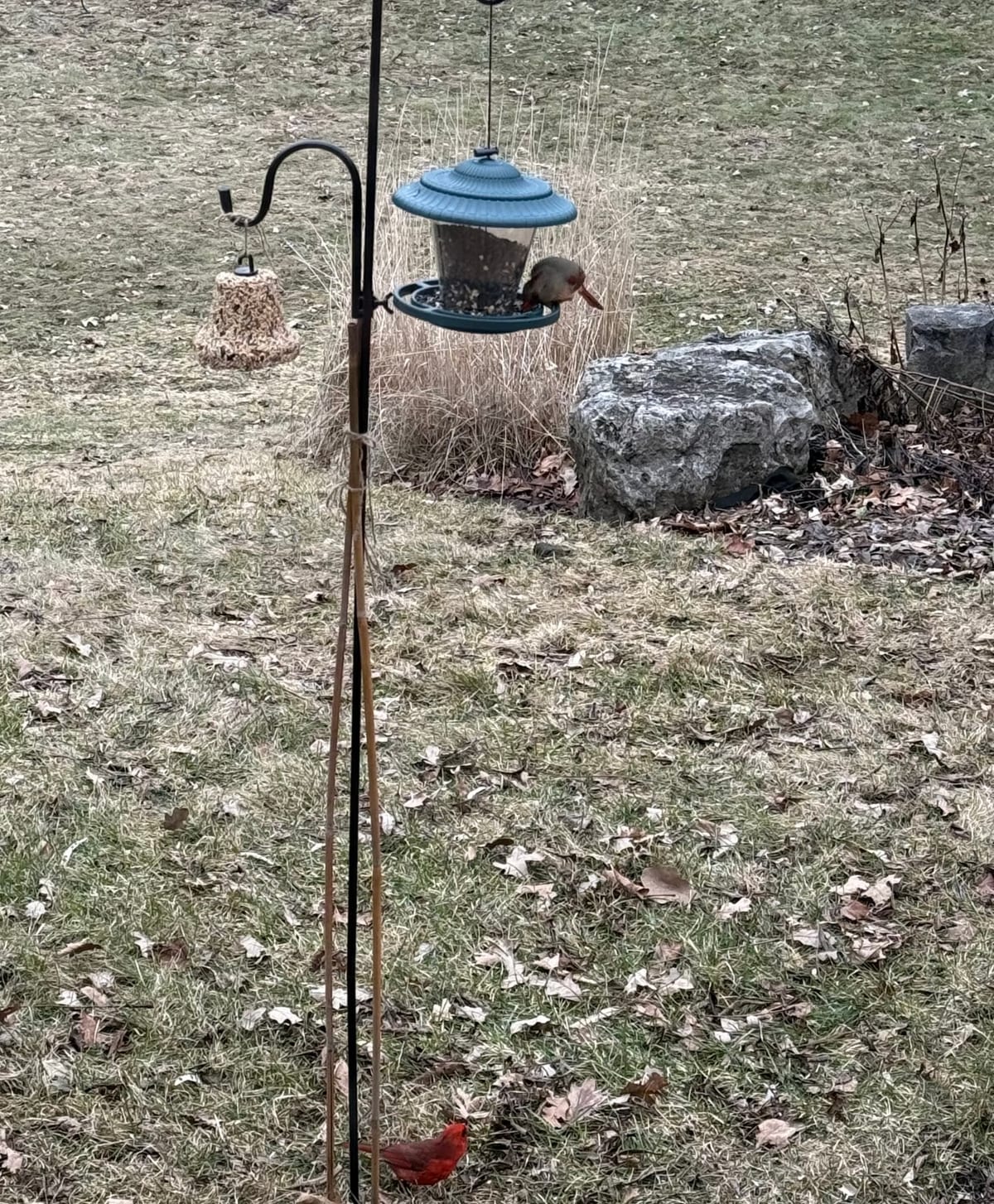
This article contains no affiliate links. The reasoning about cracked corn and about mulch depth is our own and is not attributed to any source. The photograph was taken by our contributor yuanyuan and is used with permission.