
Types of Bird Food and What Each One Attracts
The types of bird food on the shelf are not competing. Sunflower is the generalist, and every other bag is a key to a bird sunflower cannot reach.
The types of bird food on a shop shelf look like competitors. They are not. One of them does the general job, and the rest exist because there are birds that the general one never reaches.
So the question is not which food is best. Sunflower settled that. The question is which bird you are missing, and which single bag is the key to it.
Which food does the most work?
Black-oil sunflower, and it is not close.
The first name on that list is also the bird most often shut out by feeder hardware, which is its own problem. The reach is the point: Black-oil sunflower is among the favorite feeder foods of cardinals, chickadees, finches, and sparrows. Woodpeckers even consume these seeds on occasion.
Four families and a bonus. If you buy one thing, this is the thing.
Then why does the aisle carry ten more bags?
Because a few birds are not on that list, and each of the other foods opens one door.
The clearest evidence that variety is not the same as improvement comes from safflower, which is marketed as an upgrade. FeederWatch describes what it does: Grown for its oil and for bird seed, safflower attracts cardinals and other big-billed birds. Then it adds a qualifier that the packaging never carries: However, in our experience, most birds prefer sunflower seeds over safflower.
Safflower reaches roughly the birds sunflower already reaches, slightly less well. It has a separate argument in its favor, which is what squirrels make of it, and that is a trade rather than an upgrade.
The foods worth adding are the ones that reach somewhere sunflower does not.
What seed attracts which birds
| Food | What it opens | What it needs |
|---|---|---|
| Black-oil sunflower | Cardinals, chickadees, finches, sparrows | Any standard feeder |
| Safflower | Much the same list, less preferred | Same, plus a squirrel argument |
| Nyjer | American Goldfinch, Pine Siskin, Common Redpoll | A special small-port feeder, fed alone |
| Millet | Juncos, sparrows, ground foragers | Scattered on the ground |
| Cracked corn | Doves, quail, sparrows | Ground or platform, often mixed with millet |
| Peanuts | Jays, and chickadees, nuthatches, titmice if shelled | Shell size decides who can use it |
| Mealworms | Bluebirds, plus chickadees, titmice, wrens, nuthatches | A flat tray or mealworm feeder |
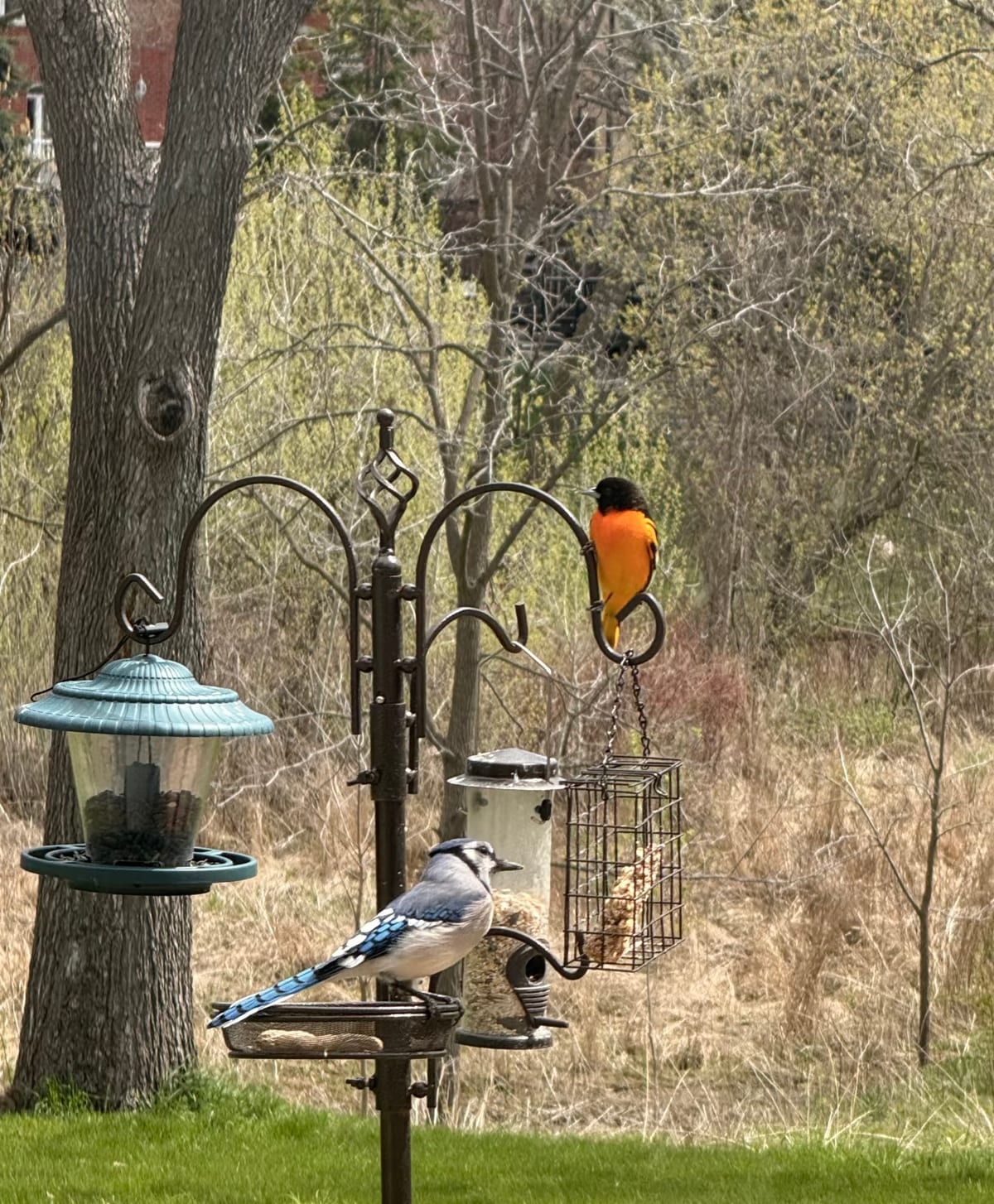
| Fruit | Orioles, mockingbirds, catbirds, robins, waxwings | Halved oranges, grapes, raisins |
| Suet | Insect-eating birds | A suet cage |
| Milo | Little, and much of it is wasted | Best avoided in the east |
Two of those rows have their own articles already. Suet is the fat that stands in for winter insects, and milo is the grain at the center of whether birds eat milo at all, where FeederWatch's verdict is that it is not a favorite of most birds, and the seed often goes to waste.
Read the right-hand column, because it is the part people skip. Most of these foods do not just change the bag. They change the equipment.
How to attract goldfinches to a feeder
Nyjer, and it comes with conditions.
FeederWatch on what it is, which corrects a name almost everyone uses wrongly: Often called "thistle" seed, nyjer is not related to North American thistle plants but comes from the Guizotia abyssinica plant native to Africa.
And two conditions that decide whether it works at all. The first is hardware: Because nyjer seed is so small it requires a special feeder with very small feeding ports. The second is that it should not be bought as part of a blend: To prevent waste, it is best to feed nyjer seed by itself (rather than in a mix).
That second point is worth holding onto next time a mixed bag advertises nyjer content on the front, and it is the first thing to check when the finches are ignoring your nyjer.
One incidental fact, because it explains why the seed never sprouts under the feeder, and it is the only item in this list with a settled answer on what germinates under a feeder and what cannot: Seeds are heat-treated prior to importation to prevent sprouting.
Which birds can only be reached on the ground?
The ones that will not land on a feeder at all. For those species, food and feeder type are a single decision wearing two labels.
Millet is the simplest version: Millet is a favored food of many smaller, ground foraging birds, and the instruction is as basic as it sounds, since A handful of millet sprinkled on the ground will keep your juncos and sparrows happy.
Cracked corn works the same way and reaches a slightly different set: Whole corn is a favorite of Wild Turkeys and ducks, while cracked corn will attract doves, quail, and sparrows. FeederWatch suggests combining them: To attract these birds, try mixing cracked corn with millet and feeding a scoopful on the ground or a platform feeder.
Two pieces of advice on this site pull against each other here, and pretending otherwise would be worse. Ground feeding is the only way to reach those species. It is also the exact condition that makes a yard useful to a cat, which is why the cats article names it as the one recommendation here to skip if cats visit your yard.
Both statements are true. The resolution is not a compromise but a fact about your own yard: if cats come through, these birds are off the menu, and a platform feeder at height is the nearest partial substitute.
What is the only reliable way to get bluebirds?
Mealworms, and FeederWatch states it in unusually absolute terms.
Mealworms are the larvae of the mealworm beetle, Tenebrio molitor, and they provide a high protein treat for many birds. The line that matters: Birds like chickadees, titmice, wrens, and nuthatches relish this food and mealworms are one of the only food items that reliably attract bluebirds.
"One of the only" is a strong claim from a source that hedges elsewhere on this same set of pages. If bluebirds are the goal, no amount of seed substitutes for this.
One qualification, from a different authority. The North American Bluebird Society warns that mealworms will not produce bluebirds in a yard that has never had them. The two statements answer different questions, and the difference is worth understanding before you buy a tub.
Delivery again decides it: Offer mealworms on a flat tray or in a specialized mealworm feeder. NABS is more restrictive on this point, ruling out ground and open trays in favor of a hopper with small end holes, and it also caps the quantity, since mealworms are calcium depleting.
And mealworms are only half the bluebird question. The other half is housing, which is covered in what a nest box entrance hole can and cannot exclude.
What about birds that do not eat seed at all?
Fruit, and it reaches a list that overlaps with nothing above.
Oranges cut in half will often attract orioles which will sip the juice and eat the flesh of the orange, and beyond orioles, Mockingbirds, catbirds, bluebirds, robins, and waxwings are all species that are likely to feed upon fruit.
Softer options work too: Grapes and raisins (no preservatives, please) are a favorite of many fruit-eating birds.
Which of these carry a safety rule?
Three do, and they are easy to miss because they sit at the end of otherwise cheerful paragraphs.
Peanuts must be plain. You can offer raw or roasted peanuts, but avoid salted peanuts or peanuts that have been roasted with any coatings or flavorings. Shell size also decides the audience, since Larger birds like jays may grab several peanuts at a time and fly off to hide them for later consumption while Smaller birds like chickadees, nuthatches, and titmice will have more success feeding on shelled peanuts.
Fruit has a deadline. Be sure to dispose of any fruit that becomes moldy because some molds create toxins that are harmful to birds. That belongs with the rest of what should never be offered.
Suet has a temperature. Plain suet goes rancid in warm weather, which is covered where it matters most.
Which types of bird food should you actually buy?
Work backwards from a bird, not forwards from a shelf.
If you cannot name a bird you want and are not seeing, the answer is one bag of black-oil sunflower and nothing else. Adding safflower or a mixed bag will not increase the number of birds; it will spend money on seed that lands on the ground.
If you can name one, the food follows from it. Goldfinches mean nyjer and a small-port feeder. Bluebirds mean mealworms and a tray. Juncos and sparrows mean millet at ground level, with the cat question settled first. Orioles mean an orange cut in half.
One caveat about these ten verdicts. They all come from the same organization. Project FeederWatch runs the largest feeder-bird dataset in North America, which is why its judgments are worth quoting, but a single source means no second opinion built in. Where another authority disagrees, we have said so elsewhere: the safflower and squirrel question is the clearest case on this site.
Fruit is the row with the most behind it, because the birds it reaches will not touch seed at all. What to put out, when to put it out, and how fast it has to be replaced are in how to attract orioles.
Questions people ask
What is the best all-round bird food? Black-oil sunflower. FeederWatch describes it as high in energy with thin shells, making it the preferred food for a wide variety of birds including cardinals, chickadees, finches, and sparrows.
What seed attracts goldfinches? Nyjer. It needs a feeder with very small ports, and FeederWatch advises feeding it on its own instead of in a mix to prevent waste.
What food attracts bluebirds? Mealworms. FeederWatch calls them one of the only food items that reliably attract bluebirds, offered on a flat tray or a specialized feeder.
What do you feed ground-feeding birds? Millet and cracked corn, scattered on the ground or on a platform feeder. That reaches juncos, sparrows, doves, and quail, none of which reliably use a hanging feeder, and it is the starting point for attracting doves deliberately.
Can you feed birds peanuts? Yes, raw or roasted, but never salted or roasted with coatings or flavorings. Shelled peanuts suit chickadees, nuthatches, and titmice; jays take them whole.
Is safflower better than sunflower? Not for attracting birds. FeederWatch says most birds prefer sunflower. Safflower's argument is about squirrels rather than about birds.
Types of bird food: the short version
Sunflower is the generalist and everything else is a key. Nyjer opens finches, millet and corn open the ground feeders, mealworms open bluebirds, fruit opens orioles and waxwings, suet opens the insect eaters, and milo opens almost nothing.
Most of those keys come with a lock attached: a small-port feeder, a flat tray, a patch of open ground, half an orange. Buying the bag is rarely the whole change.
So the useful exercise is not comparing bags. Stand at the window, name the bird you keep hoping for and never see, and buy the one thing that reaches it. If no name comes to mind, sunflower is already doing the job. Types of bird food only matter once you can name the bird you are buying for.
The photograph in this article was taken by our contributor yuanyuan and is used with permission. More on where our photographs come from.