
Rats Under the Bird Feeder: What Works, and What You Are Responsible For
Rats under bird feeders come for spilled seed. The measurements that reduce it, why cheap seed makes it worse, and what local codes require of you.
Rats under the bird feeder are the predictable result of putting food outdoors, and the public health department that wrote the clearest guidance on this says so without hedging: if you feed birds expect to see increased rat numbers around your home.
That is the honest starting point. The useful question is not how to feed birds with no rats at all, but how to keep the spilled seed low enough that a passing rat does not become a resident colony. There are specific measurements for that, and there is also a legal dimension most bird-feeding advice never mentions.
Do bird feeders actually attract rats?
Yes, and the mechanism is the seed on the ground rather than the feeder itself. It is the same accumulation that decides what sprouts underneath, so one catch tray answers both.
Public Health Seattle and King County put it plainly: Bird seed easily spills out of feeders onto the ground, and it is impossible to remove all of it.
That sentence is worth sitting with, because it rules out the fantasy solution. You are not going to sweep your way to zero. Every feeder drops seed, birds themselves scatter it while sorting through a mix, and some of it lands where you cannot reach.
Two further facts change how the problem should be approached. The feeder itself is reachable: Rats are good climbers and frequently access bird feeders hanging in trees. And rats do not forget a good site: Rats are attracted to bird seed and will return often for this favorite food.
University of California's Integrated Pest Management program names the same cause in residential settings, listing spillage from bird feeders alongside pet food left outdoors as things that encourage rodent infestations.
Rats are also not the end of the chain. What comes to a yard for the rats a feeder produces, snakes and bobcats included, is its own list.
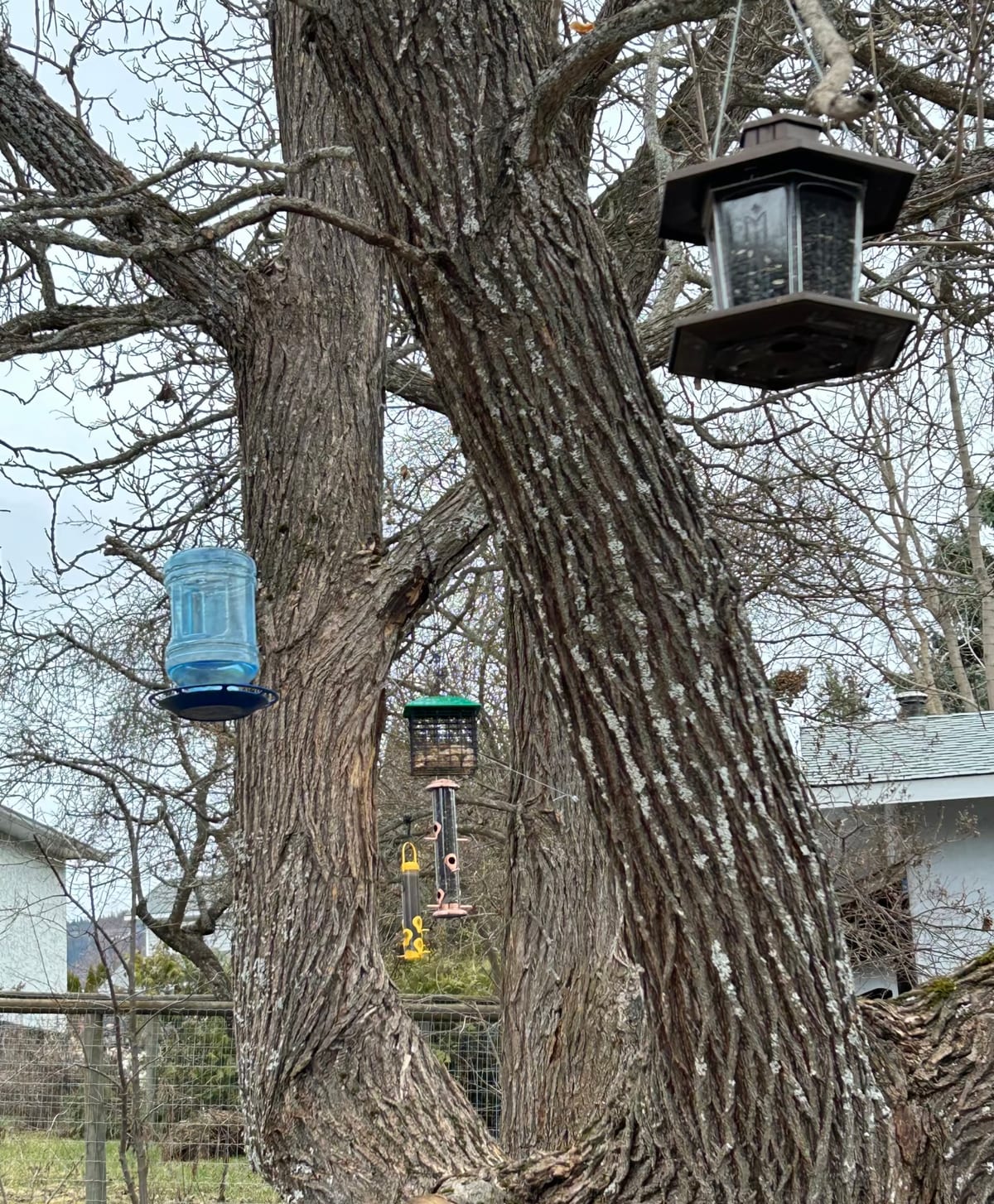
How to stop rats around a bird feeder
Three things, and two of them are measurements.
Bird feeder height to avoid rats
King County gives numbers: Place feeders four feet off of the ground and 8 feet out and away from any branches, fences, or other objects that rats may use to jump on to feeders.
Note that this is the same logic as squirrel clearance but with different numbers, because rats jump differently. If you have already positioned a feeder using the ten-foot rule for squirrels, you are most of the way there.
A tray that catches what falls
King County's equipment recommendation is a squirrel proof feeder with a tray and a baffle that will prevent seed from spilling on the ground. The baffle blocks the climb and the tray catches the spill, which are the two routes to the seed.
Cleaning up what still lands
Spillage cannot be engineered away, and clearing it overlaps with the cleaning you should already be doing, since decomposing hulls under a feeder are a disease problem before they are a rodent problem.
Why does cheap seed make the rat problem worse?
Because filler is the part that ends up on the ground.
King County makes the link directly, noting that seed blends heavy on filler grains such as milo or sorghum tend to end up on the ground where they attract rats. That is the same grain most birds refuse, and whether birds eat milo has a regional answer that decides how much of a bag reaches the ground in the first place.
This is the same causal chain from the other end. A bargain mix is cheap because of what fills it out, and birds sort through the mix and discard what they will not eat. That rejected filler does not vanish. It accumulates under the feeder, which is exactly where a rat looks.
So the cheap bag has a third cost, after wasted money and wasted effort: it feeds something else.
What should you do at night?
Take the seed in, or run the feeder empty by dusk.
King County's instruction is specific about timing: Do not leave any bird seed in feeders overnight. That is when rats are most active.
The way to make that practical is portion control rather than nightly disassembly: Do not overfill the bird feeder with seed. Fill it with the minimum amount of seed that the birds might completely consume in a day.
A feeder sized to a day's feeding empties itself on schedule. A feeder filled to the brim on Sunday is an overnight buffet for a week.
How to store bird seed against rodents
In a metal container.
If that sounds excessive, the evidence for rodent teeth versus plastic is sitting in our photo library already.
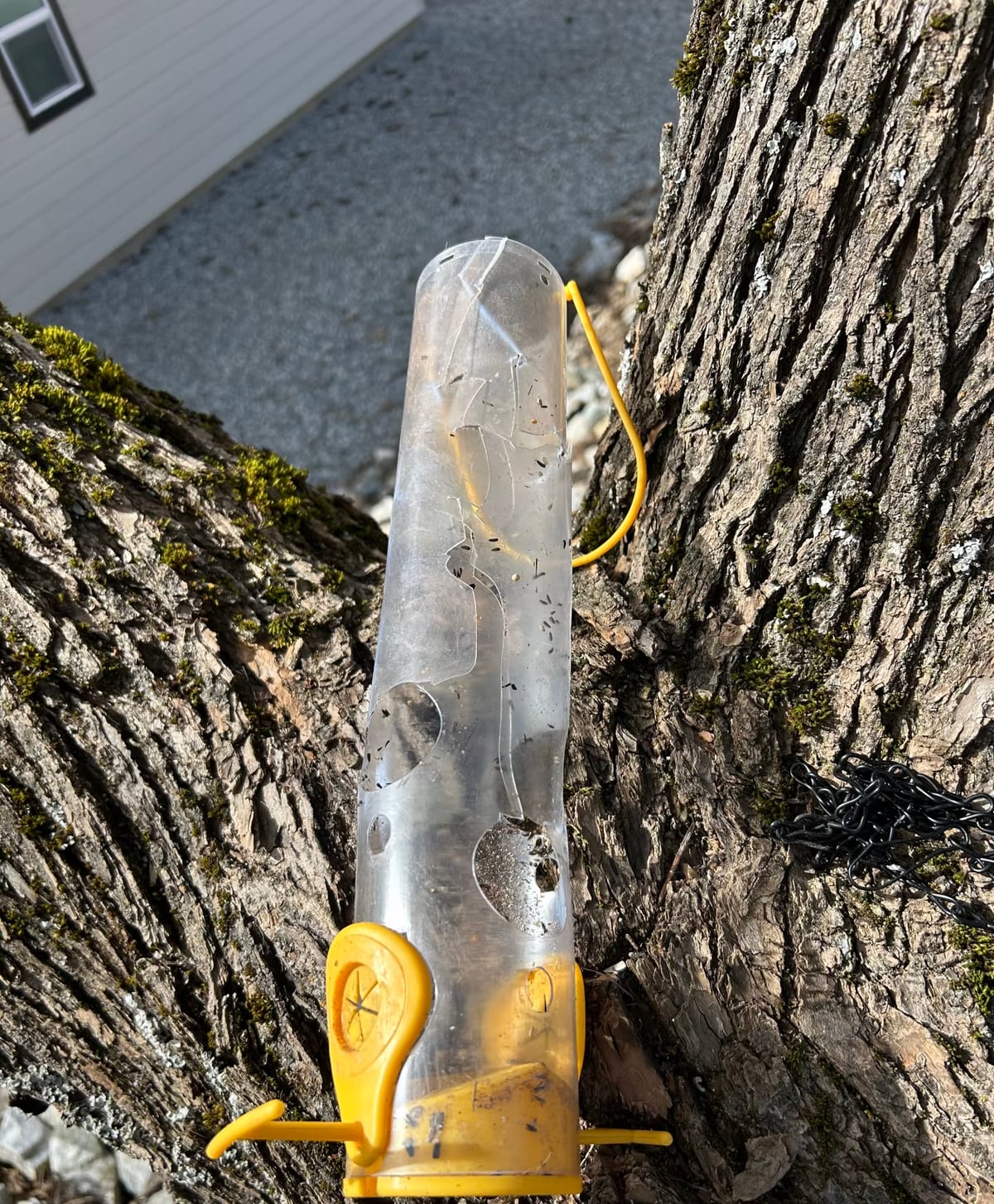
A storage bin in a garage is a quieter, more sheltered target than a feeder in the open, which makes it the more attractive one.
What if you already have rats?
The feeding stops until the problem is dealt with, because the control effort depends on it: If you have an active rat infestation, you must remove bird seed for trapping and poisoning efforts to be successful.
A rat that has a reliable seed supply has no reason to take bait. Leaving the feeder up during an eradication attempt is paying for pest control and then feeding the pests.
Rats under a bird feeder: what works, what delays, and what makes it worse
| Works | Only delays | Makes it worse |
|---|---|---|
| Four feet up, eight feet from any jump-off point | Sweeping occasionally | Filler-heavy mixed seed |
| Tray plus baffle to catch and block | Moving the feeder a short distance | Overfilling the feeder |
| Day-sized portions, nothing overnight | Hoping birds finish it | Leaving seed out overnight |
| Metal storage containers | A tightly sealed plastic bin | Feeding through an active infestation |
Is this your legal responsibility?
In many places, yes, and the wording is more specific than people expect.
Bird food is named in the code. King County's Board of Health Rodent Control Regulations require that the owner or occupant of premises Implement rodent-proofing and eradication measures to prevent rats, mice, or other rodents from gaining access to or coming into contact with food, food products, animal food, or bird food. Not "food generally." Bird food, listed as its own category.
The duty is absolute in form. The same section requires owners and occupants to Maintain all premises free from rats, mice, and other rodents, and the chapter states that its intent is to place the obligation of complying with its requirements upon owners and occupants of land, buildings, or other structures.
Other jurisdictions frame it as a structural duty. Portland's city code, section 29.30.130, requires that Every structure must be kept free from insect, rodent, vermin or other pest infestation, and where found, infestations must be promptly exterminated as set forth in the administrative rules. After extermination, proper precautions must be taken to prevent reinfestation.
What this does and does not mean. None of these codes ban bird feeders. What they do is place the consequences of a rodent problem on the property owner, and at least one of them names bird food explicitly as something rodents must be prevented from reaching. So the legal question is never "am I allowed to feed birds," it is "is my feeding creating a condition I am required to prevent."
These are two jurisdictions out of thousands. Rodent codes are local, they are written differently in every city, and some places have gone further than the two quoted here. Check your own municipality or county health department before assuming either that you are fine or that you are in trouble. The framework is what transfers between places. The specific numbers do not.
Rodent duty is also only one of the ways local law can reach a feeder. A separate body of ordinance governs feeding itself, and it is worth knowing which shape yours takes before a dispute starts: is it illegal to feed birds in your backyard.
Questions people ask
Do bird feeders attract rats? Yes. Public Health Seattle and King County states that if you feed birds you should expect increased rat numbers around your home, because seed spills onto the ground and cannot all be recovered.
How high should a bird feeder be to avoid rats? Four feet off the ground and eight feet away from branches, fences, or anything else a rat could jump from, per King County.
Does taking the feeder in at night help? It is one of the more effective single changes, because rats are most active overnight. King County advises leaving no seed in feeders overnight and filling only what birds will finish in a day.
Can I keep feeding birds while dealing with a rat problem? No. King County states that bird seed must be removed for trapping and poisoning to succeed, since a rat with a reliable food source has no reason to take bait.
What kind of container should bird seed be stored in? Metal. Rats chew through plastic containers.
Is it against the law to have a bird feeder? Feeding birds is not prohibited by the rodent codes reviewed here. What those codes require is that property owners prevent rodents from accessing food, and King County's code names bird food specifically. Rules are local, so check your own city or county.
Rats under the bird feeder: the short version
Spilled seed is the attractant and it cannot be fully cleaned up, so the goal is reducing how much reaches the ground rather than eliminating it. Four feet up, eight feet of clearance, a tray under the feeder, day-sized portions, nothing left overnight, and seed stored in metal. Filler-heavy mixes make all of it worse because the rejected grain lands on the ground. If an infestation is already active, the feeder comes down until it is over.
And the part that separates this from a nuisance: in places like King County, keeping rodents away from bird food is not a courtesy to the neighbors. It is written into the health code as the property owner's job. Rats under bird feeders are, in that reading, a maintenance failure rather than bad luck.
The photographs in this article were taken by our contributor Kevin Hu and are used with permission. More on where our photographs come from.