
How to Attract Orioles: Oranges, Jelly, and the Window You Cannot Miss
How to attract orioles: halved oranges and grape jelly, on something they can perch on. Miss their arrival week and you may miss the whole summer.
How to attract orioles comes down to two foods and one deadline. The foods are halved oranges and grape jelly. The deadline is their arrival in spring, and missing it can cost you the entire season rather than a few weeks.
Everything else, including which feeder you buy, follows from a physical fact about the bird: an oriole cannot hover, so it has to be able to stand up while it eats.
How to feed orioles oranges, and what else they come for
Fruit and sugar, offered in a form they can reach.
Audubon's guide to attracting them is specific about both the food and the vessel: Lure orioles and tanagers up close by offering halved oranges on spikes or grape jelly in special feeders or small bowls.
Its backyard feeding guide gives the same pairing with a placement note attached: To attract orioles and tanagers, skewer halved oranges onto a spike near other feeders, or supply nectar feeders.
Nectar is a genuine third option, because these are not only fruit eaters. Audubon: Hummingbirds and orioles are the main nectar drinkers, but mockingbirds, grosbeaks, tanagers, and several warblers also enjoy sweet drinks from flowers and tree sap.
We are not going to print a sugar ratio for oriole nectar. The ratio widely repeated online is different from the hummingbird one, and we could not find it stated by any of the sources used here. What Audubon does state, for any nectar feeder, is that you do not use honey in feeders, as this can grow mold, and that red coloring is unnecessary. Those rules are the same ones that govern a hummingbird feeder.
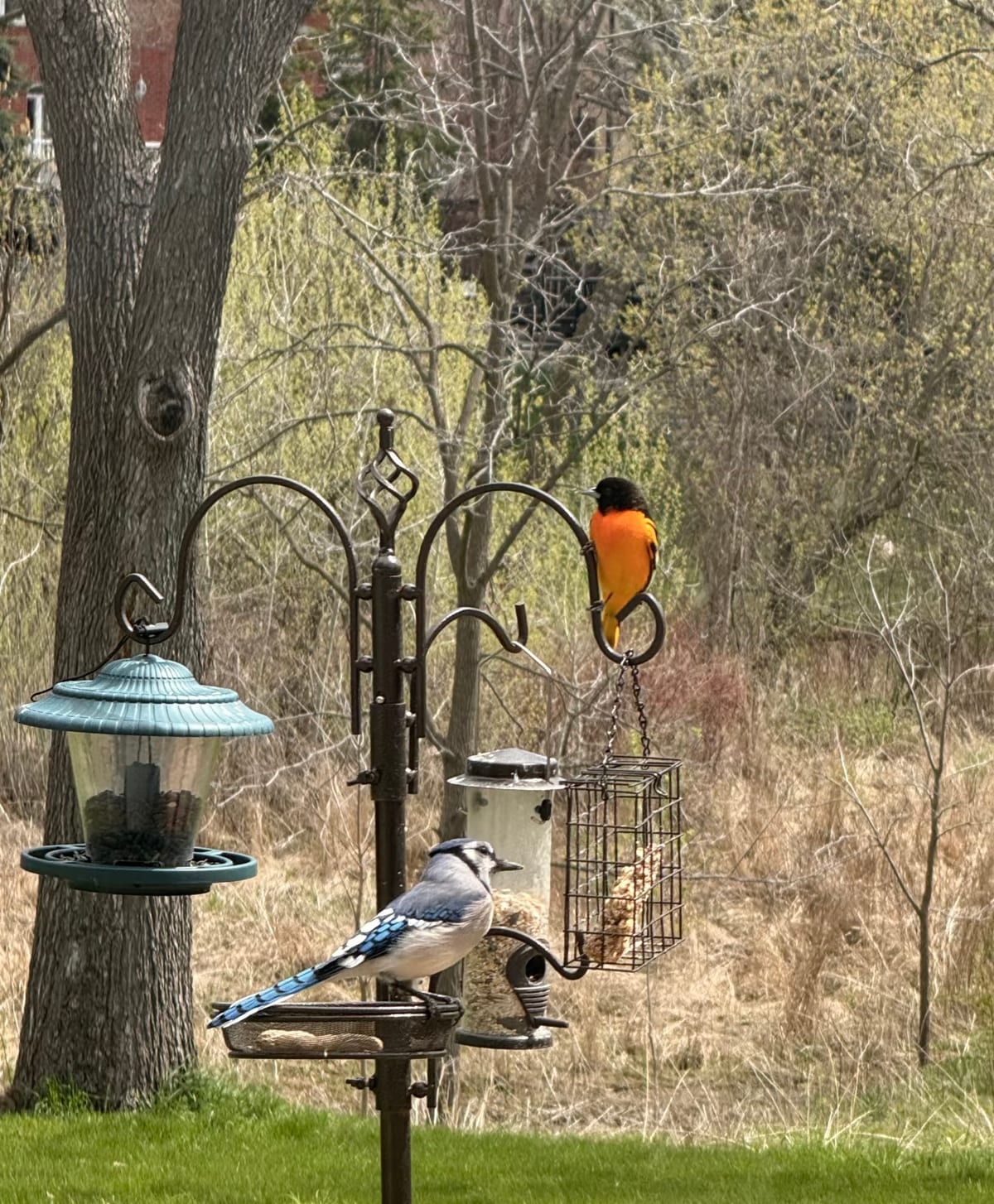
When to put out oriole feeders
Before they arrive, because the arrival window decides the season.
Nebraska Extension states the stake plainly: If your food supplies are not available when birds first move into your area in spring, then you may not be able to attract them all summer.
That is a stronger claim than the usual advice to hang things early. It says the arrival window is when a bird decides whether your yard is on its route, and a feeder that appears two weeks later has missed the decision rather than the meal.
The same page pairs it with the disposition required: Experts say that timing and patience are key to attracting orioles, and Place your feeders out where birds can see them, and be patient.
How to find your own date. Nobody can give you a national one, and none of these sources tries. The method that works for hummingbirds works here: check eBird for the first local sightings in previous springs and hang the feeder a couple of weeks before that. The same approach, applied to the other end of the season, is how the autumn nectar question gets answered.
Grape jelly for orioles, and how often it has to change
Jelly is the food most associated with orioles, and it comes with a maintenance schedule that is shorter than most people keep.
Nebraska Extension: Clean the jelly feeder every 2 to 3 days too, and provide new jelly to prevent the development of harmful bacteria.
Oranges for orioles run on a different and faster clock: Be sure to change the orange halves every day or two, to prevent them from rotting.
Two schedules rather than one, and the fruit is the more urgent of them. That distinction gets lost in most write-ups, which treat the whole oriole station as a single chore.
On quantity, we have a gap and we are going to say so. Advice to offer jelly only in small amounts circulates widely, and we could not trace it to any of the sources used here. What is sourced is the replacement interval, not a serving size. If you want a conservative reading, the interval itself limits you: a dish sized to be emptied within two or three days does not become a standing sugar buffet.
Grapefruit and marmalade
Both get asked about, and neither appears in any guidance we could find.
Every source used on this page names oranges and grape jelly specifically. None mentions grapefruit; none mentions marmalade. That is not evidence they fail, but the recommendation being copied was written about something else.
Marmalade is worth separating from jelly for a reason beyond sourcing. It is a different product, made with peel and usually with added pectin and preservatives, and the guidance on this site is consistently against substituting a processed version for the plain one a source actually named. The parallel case, why raw and unprocessed sugars are excluded from nectar even though they sound more natural, is in the hummingbird nectar recipe.
Grapefruit is a halved citrus on a spike like any other. If you try it you are running the experiment, not following advice.
Where it goes, and why perches matter
An oriole feeder is not a large hummingbird feeder, and the reason is anatomical.
Nebraska Extension gives it directly: since they are bigger birds and cannot hover like hummingbirds do, they need a sturdy branch to perch while feeding.
That single fact explains the whole product category. Ports sized for a hummingbird are useless to a bird that must stand, and a feeder with nowhere to stand is a feeder an oriole will look at and leave.
Oriole feeder placement therefore matters more than the vessel does, and the vessel itself is negotiable. Nebraska Extension is relaxed about the hardware: Specially designed oriole feeders are available, but a small flat-bottomed, hanging birdbath also makes a good place for oranges and jelly.
For placement, the habitat around the feeder is worth matching to the bird. The same source describes where they nest: When nest building, orioles prefer tall, leafy deciduous trees on the edge of woodlands, river banks or small groves of trees, not deep forests.
Edge habitat rather than deep cover, in other words, which is the same shape of yard that the general placement rules already push you toward.
Hummingbird feeder vs oriole feeder
They look like variations on one idea and they are built around opposite feeding styles.
| Hummingbird feeder | Oriole feeder | |
|---|---|---|
| Feeding posture | Hovering, no perch required | Standing, a perch is mandatory |
| Port size | Sized for a fine bill | Wider, or an open dish |
| Typical food | Sugar water | Grape jelly, orange halves, nectar |
| Replacement clock | Nectar by temperature, faster in heat | Jelly every 2 to 3 days, oranges every 1 to 2 |
| Color convention | Red | Orange |
| What goes wrong first | The nectar clouds | The fruit rots and the jelly ferments |
The last row is the practical difference. A nectar feeder fails invisibly, which is why cloudiness is the signal to watch. An oriole station fails visibly, and by then the insects have found it.
What else the fruit will attract
Insects, reliably, and it is worth planning for rather than reacting to.
Maryland's Department of Natural Resources attaches the warning to the recommendation itself: Orange slices are an excellent attractant for Baltimore Orioles in the spring, but be careful of ants and wasps which might also enjoy fruit offerings.
Sugar and exposed fruit are the same draw a nectar feeder presents, so the fixes are the ones already established: a moat above the dish for ants, and cleanliness rather than guards for wasps. The full version, including why bee guards work on bees and barely slow wasps, is in ants and bees at a nectar feeder.
Fresh fruit also carries the general rule from the food side of this site: fresh only, and cleared before it molds, which is where dried fruit falls down.
Questions people ask
How do you attract orioles to your yard? Halved oranges on a spike and grape jelly in a small dish, put out before the birds arrive in spring, on something sturdy enough for a bird that cannot hover.
When should I put out oriole feeders? Before their first arrival in your area. Nebraska Extension warns that if food is not available when they first move in, you may not attract them all summer. Use local eBird records from previous springs to find your date.
How often do you change grape jelly for orioles? Clean the jelly feeder and replace the jelly every two to three days, per Nebraska Extension, to prevent bacteria.
How often do oranges need changing? Every day or two, before they rot. That is a faster schedule than the jelly.
Do I need a special oriole feeder? No. Nebraska Extension says a small flat-bottomed hanging birdbath works for oranges and jelly. What you cannot skip is somewhere for the bird to stand.
Can I use a hummingbird feeder for orioles? Not usefully. Orioles cannot hover and the ports are the wrong size. They need to perch, which is the difference the two feeder designs are built around.
Will jelly attract ants and wasps? Yes, and so will the oranges. Maryland DNR flags exactly this. An ant moat above the dish handles the ants; wasps are harder, and the answer there is keeping the station clean rather than buying a guard.
How to attract orioles: the short version
Two foods, one clock, one physical constraint. Oranges and grape jelly, changed on schedules that differ from each other, offered on something an oriole can stand on.
The part worth acting on first is the timing, because it is the only one you cannot fix later. Nebraska Extension's warning is that a yard without food when the birds arrive may go unvisited all summer, which turns a week of preparation into the whole season's difference.
So find the date orioles reached your county in previous springs, put the dish out two weeks before that, and accept that the first year may be a season of patience. The oranges will rot before anything comes, and that is the cost of being early rather than evidence of being wrong. How to attract orioles is one week of preparation and then a season of waiting to find out whether it worked.
This article contains no affiliate links. Nothing here is a first-hand sighting: every claim about oriole behavior is attributed to the source that published it. The photograph was taken by our contributor yuanyuan and is used with permission.