
What Not to Feed Birds (and Why Bread Is the Wrong Argument)
What not to feed birds starts with bread, but the reason everyone repeats is the one every authority hedges. The harms stated plainly, and what to offer.
What not to feed birds begins with bread. That much is settled, and the US Fish and Wildlife Service says so without qualifying it.
What is worth noticing is that the reason repeated most often is the one every source hedges on, while two others are stated flatly. If you are trying to convince someone at a duck pond, you are probably using the weakest argument available.
Is bread bad for birds?
Yes. The US Fish and Wildlife Service lists it among the things to avoid and gives two mechanisms, neither of them hedged.
The first is contamination: Providing bread to birds can be detrimental to their health. Bread and sugar sponges can quickly introduce harmful bacteria and mold, causing respiratory issues and disease, sometimes resulting in death.
The second is displacement: Birds easily fill up on bread, leaving little room for the more nutritious foods they need.
And the consequence of that second one has a name: Just like people, animals can suffer from metabolic bone disease if they don't get the proper nutrients. Even with treatment, this disease is often irreversible. In the wild, animals may starve to death or be unable to escape predators.
Bacteria and mold. Displaced nutrition. Irreversible disease. None of that comes with a "may".
The same mechanism has a milder version that catches careful feeders out, since a food can be good and still displace the rest of a diet if you give too much of it. That is the argument for capping how many mealworms go out, which both bluebird authorities describe as calcium depleting.
Why angel wing is the weakest argument against bread
Angel wing is the deformity that gets cited in almost every warning about feeding bread, usually as established fact. The authorities themselves are more careful than that.
Audubon's magazine states it with a qualifier: Bread has little nutritional value and may cause an unhealthy condition referred to as "angel wing."
Audubon California, writing about ducks photographed with the condition, hedges twice in the same short piece. First about those particular birds: they have "angel wing", which may have been caused by consumption of bread left by human visitors. Then about the condition in general: The sad truth is that this condition may be caused by eating bread left by well-meaning park visitors.
Three authority pages, three qualifiers, on the claim the internet repeats as settled.
To be clear about what this does and does not mean. It is not evidence that bread is fine, and it is not a claim that the link has been disproven. We looked for an authority stating the causal link more firmly, and for one stating that causation is unproven, and found neither. What we can report is the language the sources actually use, and they use "may".
The effect on the argument is worth understanding. Angel wing is dramatic and visual, so it is the version that spreads. It is also the version someone can push back on. The contamination and nutrition arguments have no such weakness, and they are the ones the federal agency states outright.
Audubon California does give a mechanism for why young birds are the vulnerable ones: While kids can get away with eating junk food once in a while, young birds can't. Birds grow much faster than humans. What they eat is very important to their proper growth.
What should go out instead?
For waterfowl, Audubon names substitutes and attaches a limit: Opt instead for cracked corn or oats, in moderation.
The moderation clause is doing real work, because overfeeding creates its own problems regardless of what the food is: Leftovers from overfeeding can contaminate water, spread diseases, and attract rodents.
That last item will be familiar if you have read what uneaten seed under a feeder attracts. The mechanism is identical. Food that is not eaten becomes food for something else.
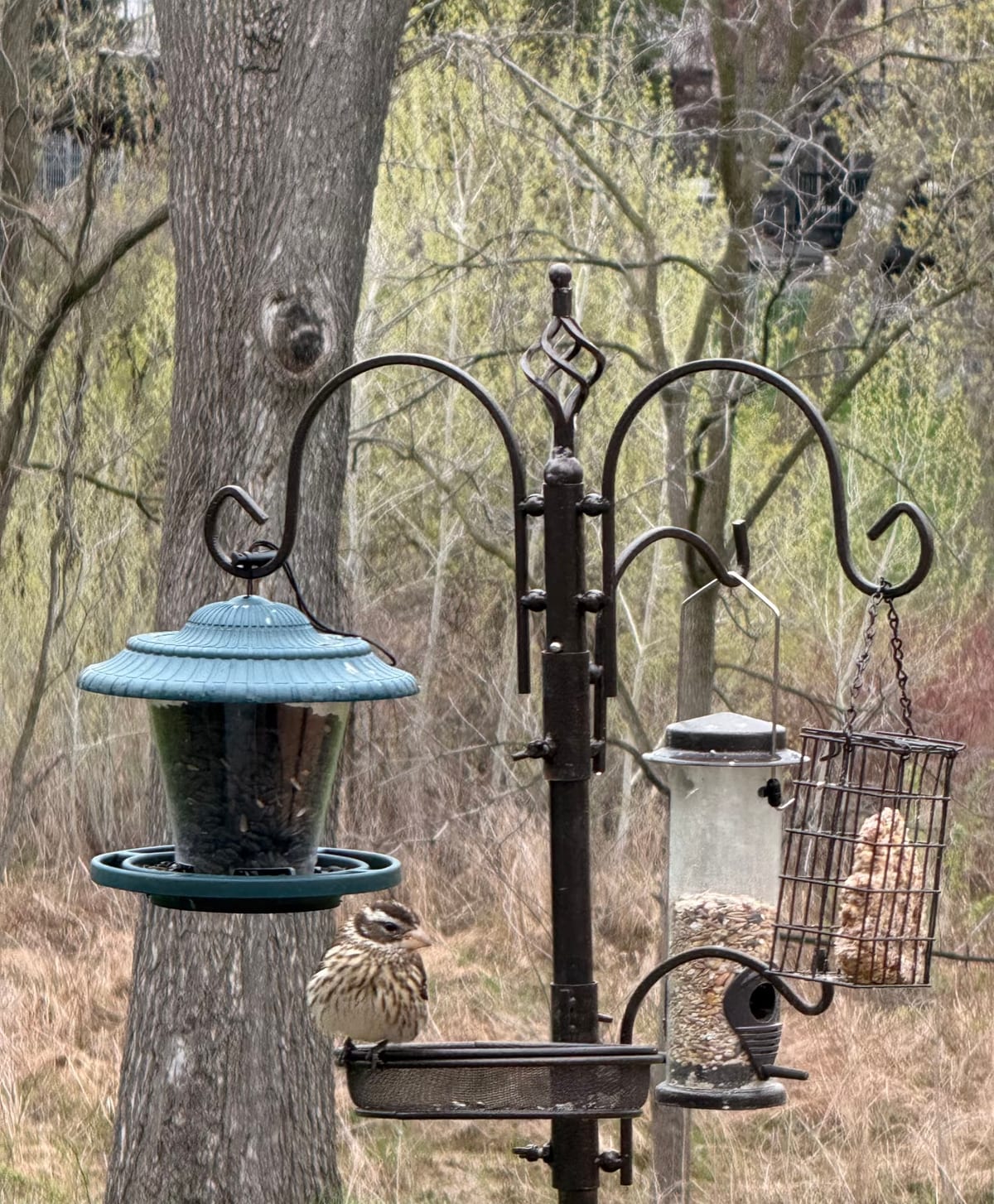
Does any of this apply to a backyard feeder?
Partly, and the distinction is worth drawing because most bread warnings are written about a different situation.
The classic bread scenario is a park pond with resident waterfowl: birds concentrated in one place, food thrown on the ground and into the water, and leftovers sitting in the shallows. Audubon California's piece opens on exactly that memory of taking bread to the pond.
A backyard feeder is a different set of conditions. Nobody is putting bread in a tube feeder. What carries over is not the bread specifically but the two mechanisms behind the warning, and both of them have backyard versions covered elsewhere on this site: contamination through wet, spoiling food, and food that displaces better food.
So the practical translation is that you are unlikely to make the bread mistake at a feeder. The mistakes available to you are the next three.
What must never go in a nectar feeder?
Anything other than refined white sugar, and no dye.
The full recipe, including why the ban extends to raw sugars, is in the hummingbird nectar recipe. The Smithsonian's National Zoo is direct: Always use refined white sugar (regular table sugar). Never use honey, corn syrup or raw, unprocessed sugars, and on coloring, Red dye or coloring isn't necessary to attract hummingbirds and could be harmful to the birds.
Audubon adds artificial sweeteners to the list, noting that other sweetening agents have additional ingredients that can prove detrimental, and that artificial sweeteners should never be used to make hummingbird nectar.
Honey is the one that catches people out, because it sounds like the natural choice. The full ratio and the schedule that goes with it are in the hummingbird feeder article. Sweetening the mixture to distract insects is the other version of this mistake, and there is a better answer for ants and bees at a nectar feeder.
What about seed that has gone off?
Out, not down. Mold in a feeder is not a cosmetic problem, and the reason sits at the center of the strongest argument on this page: contamination.
Bread is the one entry on the list with population-scale evidence behind it, since disease is the single documented harm in the research on whether feeding birds helps or hurts them. The handling belongs with feeder cleaning, and if you are finding sick birds rather than just bad seed, that is a different emergency.
What about cheap mixed seed?
Not harmful in the way bread is, but wasteful in a way that circles back to the same problem.
Filler grains get sorted out and dropped, and the discarded seed on the ground is what draws rodents and grows mold. The full accounting of what is in a bargain bag is in the article on seed filler.
The specific foods people ask about
Bread dominates this subject, but it is not what most people are actually holding when they ask. These are the items that come up, and some of the answers are yes.
Can birds eat rice?
Yes, and the belief that it kills them is the best-known myth in bird feeding.
Project FeederWatch answers it directly: Lots of birds eat uncooked rice in the wild. Bobolinks, sometimes called rice birds, are a good example.
The story is that uncooked grains swell inside a bird and kill it. Birds eat uncooked grain as a matter of course, and one of them is named after the crop. FeederWatch notes the custom has changed anyway: While rice is okay for birds, many wedding parties now throw birdseed instead.
So rice belongs on this page as a correction rather than a prohibition, which is a distinction most lists of forbidden foods never make.
Are peanuts and other nuts safe?
Peanuts yes, with conditions that are more specific than most guidance gives.
Peanuts are also the second lever for attracting woodpeckers. The US Fish and Wildlife Service names the audience: Peanuts in the shell and peanut pieces are especially attractive to woodpeckers, jays, nuthatches, titmice and chickadees.
Then the conditions, and there are three in one sentence: Roasted, no salt and no sugar, are the healthiest peanuts for feeding birds; avoid peanut hearts and raw peanuts.
Raw peanuts being on the avoid list surprises people, because raw sounds like the natural option. What the sentence rules out is the packet from the baking aisle as much as the salted one from the snack aisle.
Can birds eat popcorn, crackers, or anything salted?
The seasoning decides it, not the food.
Maryland's Department of Natural Resources states the rule in one line: Salted and/or sugared foods can be dangerous for small birds.
That covers salted popcorn, crackers, seasoned nuts and most of what is in a kitchen cupboard, and it explains why the answer to several different questions is the same. The same page groups the wider category with bread: Avoid feeding bread or other table scraps to birds or other wildlife. These foods can spoil quickly and grow bacteria and mold which can harm or even kill songbirds.
Can birds eat fruit?
Yes, fresh, and the qualifier is doing real work.
The limit is dried fruit: Only fresh fruit should be offered to birds as many dried fruits have added sugars that are harmful to birds. Raisins and dried cranberries are the common versions, and the sugar is added rather than inherent.
Fruit also comes with an upkeep condition and an insect problem. On upkeep: Be sure to clean fruit feeders every few days and remove any moldy fruit that may be left. On insects: Orange slices are an excellent attractant for Baltimore Orioles in the spring, but be careful of ants and wasps which might also enjoy fruit offerings, which is the same problem, and the same fix, as ants and bees at a nectar feeder.
Can birds eat oatmeal?
Yes, and which birds and in what form decide it. This site has now quoted four sources on oats and they appear to disagree until you line them up.
Project FeederWatch is the plainest: Oats grown for cereal or livestock feed are also eaten by many species of birds, and the offering method is specific, but you can try offering oats on a platform feeder or in a hopper. The audience is named too: Species most likely to be attracted to oats include doves and quail.
Doves and quail are ground birds, and a platform is the flat surface a ground bird will use. That is the whole reconciliation.
| Where oats appear | What is said | The form |
|---|---|---|
| Aelred Geis's ingredient study | Hulled oats grouped with the real losers | Loose seed in a mix |
| FeederWatch | Doves and quail, on a platform or in a hopper | Loose grain, ground-level |
| Audubon, on waterfowl | Cracked corn or oats, in moderation, instead of bread | Loose grain, at water |
| Audubon's suet recipe | Quick oats as an ingredient in a fat cake | Bound in fat |
Oats fail as a tube-feeder seed for songbirds and work for ground birds, waterfowl, and as a binder in suet. A bag of mixed seed with oats high in the ingredient list is still the wrong purchase, for the reason set out in bird seed filler, and that is a different question from whether a bird will eat oats at all.
On the porridge version. Plain rolled or quick oats are the form every source above is describing. Instant flavored sachets are a different product, sweetened and salted, which puts them under the rule two sections up rather than this one.
Can birds eat bacon fat?
No, and the rule that decides it is already on this page.
Bacon is a cured, salted product, and Maryland DNR's line covers it without needing a separate ruling: Salted and/or sugared foods can be dangerous for small birds.
The reason this question keeps coming back is that suet is animal fat, and bacon grease is animal fat that most kitchens already have. Audubon does mention it, in a passage about consistency. Suet, that page says, should be hard at room temperature, which is why most people recommend beef or lamb fat, and then though some folks have made great feeders using bacon drippings.
Read what that sentence is doing. It is answering a texture question, not a salt question, and it reports what some people do rather than recommending it. Nothing on that page addresses the salt, which is the objection Maryland DNR raises against cured food generally.
The blanket prohibition on cured fat is repeated widely on hobbyist sites and in magazine columns, none of which cite anything, and we are not going to launder that into a citation.
What we checked, and where the check stops. Audubon, Project FeederWatch, US Fish and Wildlife Service and Maryland DNR are the sources quoted throughout this page, and none of the pages we could open rules on cured fat by name. Cornell's All About Birds has a page on suet and other bird foods that refuses scripted access, so we cannot say what it does or does not contain. That is a limit on our search rather than a finding about the literature.
The part that is sourced needs none of that: bacon is salted, and salted food is named as dangerous for small birds by a state wildlife agency.
The fat that is documented for this purpose is beef fat, which is what suet for birds covers, including the summer-heat problem and two published recipes.
The cupboard items nobody has ruled on
People ask about almonds, cashews, chia seeds, breakfast cereal and half a dozen other things, and the honest answer is that we could not find a wildlife agency or research organization that names them.
That is less unhelpful than it sounds, because the sources rule by category rather than by item, and two categories decide most of a kitchen:
- Is it salted or sweetened? If yes, Maryland DNR's line settles it, and that covers roasted salted nuts, most breakfast cereal, and anything from a snack aisle.
- Is it fresh, or is it processed? Fresh fruit is endorsed; dried fruit is ruled out for added sugars. The same split is why plain oats pass and an instant oatmeal sachet does not.
Plain unsalted nuts sit outside both tests, and there the record simply runs out. Peanuts are the one nut with specific federal guidance, quoted above, and extending it to almonds and cashews would be our guess rather than anyone's finding.
One thing worth adding rather than withholding
Not everything on this page is a prohibition. Maryland DNR suggests a supplement most feeders never think of: Ground hard-boiled egg shells can provide calcium and grit essential for birds, cooked first or baked to sterilize.
Calcium is the nutrient that a fat-heavy or insect-heavy supplementary diet runs short on, which is the same reason mealworm quantities have a ceiling.
What not to feed birds, at a glance
| Item | What the sources say | How firmly |
|---|---|---|
| Bread, bacteria and mold | Can cause respiratory disease and death | Stated plainly (FWS) |
| Bread, displaced nutrition | Can lead to irreversible metabolic bone disease | Stated plainly (FWS) |
| Bread, angel wing | May cause the deformity | Hedged in all three sources checked |
| Honey, corn syrup, raw sugar | Never use in nectar | Stated plainly (Smithsonian) |
| Red dye | Unnecessary and could be harmful | Hedged on harm, plain on unnecessary |
| Moldy or wet seed | Disease risk at the feeder | Stated plainly across sources |
| Overfeeding of any food | Contaminates water, spreads disease, attracts rodents | Stated plainly (Audubon) |
| Uncooked rice | Safe. Birds eat uncooked grain in the wild | Corrected, not prohibited (FeederWatch) |
| Peanuts, roasted and unsalted | Safe, and attractive to woodpeckers, jays, nuthatches, titmice, chickadees | Stated plainly (FWS) |
| Peanut hearts, raw peanuts | Avoid | Stated plainly (FWS) |
| Salted or sugared anything | Can be dangerous for small birds | Stated plainly (Maryland DNR) |
| Table scraps generally | Spoil, grow bacteria and mold | Stated plainly (Maryland DNR) |
| Fresh fruit | Safe, and it reaches birds seed does not | Stated plainly (Maryland DNR) |
| Dried fruit | Avoid, added sugars | Stated plainly (Maryland DNR) |
| Ground eggshell, cooked | A calcium and grit supplement | Suggested (Maryland DNR) |
| Plain oats | Eaten by many species; doves and quail on a platform | Stated plainly (FeederWatch) |
| Flavored instant oatmeal | Falls under the salted-or-sugared rule | Our reading of the Maryland DNR rule |
| Bacon fat and cured fats | Salted, and salted food is called dangerous | Rule applies; no source rules on cured fat by name |
| Almonds, cashews, chia, cereal | No agency source found naming them | Unruled. Decide by the salt and processing tests |
The fresh-only rule has one place it gets tested every spring, since orange halves rot faster than most people expect. The replacement schedule is in how to attract orioles.
Questions people ask
Can birds eat bread crumbs? Yes. The US Fish and Wildlife Service says bread can introduce harmful bacteria and mold leading to respiratory disease and sometimes death, and that birds fill up on it instead of eating what they need.
Does bread cause angel wing? It may. Audubon uses that qualifier in both articles reviewed here, and so does its California branch when describing ducks that have the condition. The firmer arguments against bread are contamination and displaced nutrition.
What can you feed ducks instead of bread? Audubon suggests cracked corn or oats, in moderation, and warns that leftovers from overfeeding contaminate water, spread disease, and attract rodents.
Can you use honey in a hummingbird feeder? No. The Smithsonian's National Zoo says to always use refined white sugar and never honey, corn syrup, or raw unprocessed sugars.
Is moldy bird seed dangerous? Yes, and it should be discarded rather than topped up. Disease at the feeder is the one harm from bird feeding with population-scale evidence behind it.
Can birds eat oatmeal? Plain oats yes. FeederWatch says many species eat oats and names doves and quail, offered on a platform feeder or in a hopper. Flavored instant sachets are sweetened and salted, which puts them in a different category.
Can birds eat bacon fat? No. Bacon is cured and salted, and Maryland DNR names salted food as dangerous for small birds. Audubon mentions bacon drippings once, in a passage about whether fat sets hard, and does not address the salt.
Can birds eat almonds or cashews? No source we could find rules on them. Peanuts are the one nut with federal guidance attached, and stretching that to other nuts would be a guess.
Do I need red dye in hummingbird nectar? No. The Smithsonian states it is unnecessary and could be harmful.
What not to feed birds: the short version
Bread is genuinely bad for birds, and the case against it is stronger than the version usually given. Bacteria, mold, and displaced nutrition are stated without qualification by the federal wildlife agency. Angel wing, the argument everyone reaches for first, comes with a "may" attached in every authority page we read.
At a backyard feeder, bread is rarely the temptation anyway. Honey in the nectar is, and so is topping up a feeder whose seed has gone damp.
A rule that covers all of it: if the food was made for people, or you cannot say what it will turn into after two days of rain, it does not belong in a feeder. For the other direction, what each type of bird food actually attracts covers what is worth buying.
The same instinct goes wrong in spring with materials instead of food, and that list has changed more recently. What not to feed birds is a shorter list than the internet suggests, and the items on it are there for reasons worth knowing.
The photograph in this article was taken by our contributor yuanyuan and is used with permission. More on where our photographs come from.