
How to Keep a Bird Bath Clean (and the Soap Question Nobody Settles)
How to keep a bird bath clean: two to three inches deep, water changed every day or two, and the soap question two authorities answer differently.
How to keep a bird bath clean comes down to four things: two to three inches of water at the deepest, a change every day or two, a scrub once a week, and a position that is not underneath a feeder.
The fourth one is the reason most baths go bad. The first three are maintenance, and the last is a decision you make once and then live with all summer.
There is also a straight contradiction between two respectable sources about what to scrub with, and this article is going to show it to you rather than pick a side quietly.
Why won't birds use my bird bath?
Four things account for most of it, and three of them are settled further down this page. Birds not using bird bath water is rarely about the water itself.
- It is too deep. This is the commonest single reason, and there is a published number for it, in the next section.
- The surface is slippery. A bird that cannot get a grip will not stand in it, whatever the depth. Glazed and smooth basins are the usual offenders.
- There is nowhere to escape to. A bath in open lawn asks a bird to be wet and exposed at the same time, which is why the placement rules below are about cover rather than about looks.
- It sits under the feeder. Hulls and droppings foul it within a day, and a fouled bath is one birds avoid.
Work through them in that order. The first two are cheap to change and account for most empty baths, and neither has anything to do with how clean the water is.
How deep should a bird bath be?
Two to three inches at the deepest point, and less at the edges.
Penn State Extension gives the number and the reason in one clause: birds will only use a bath with shallow water, no more than two to three inches of water at the deepest. A songbird that cannot stand up in the water will not get into it.
Depth is also why a decorative bath often sits unused. Ornamental basins are built to look like basins, which means a steep bowl and a flat bottom, and a bird reading that shape sees water it cannot judge.
Surface matters as much as depth, and it is the specification nobody prints on the box. Penn State notes that baths made out of materials such as glazed pottery or smooth plastics are not as attractive as those with a rough surface, like concrete or terra-cotta. Wet glaze is a skating rink. The fix costs nothing: the same page suggests you provide a nonstick surface by adding a few small rocks or even bathtub stickers.
How often to change bird bath water
Every other day at minimum. Daily in summer, and the reason is not tidiness.
The two sources differ here, and the gap is worth seeing.
Audubon's maintenance list says to Refill the water every other day to keep it from bugging up.
Penn State Extension asks for more: Ideally, the water in your bird bath should be changed every day to prevent dirt and debris from accumulating.
This is where the bird bath mosquito larvae question sits, and it is the argument for taking the stricter of the two. Penn State attaches the consequence directly: Changing the water daily in the summer also prevents mosquito larvae from hatching in your bird bath, which is a concern where the West Nile virus may be present.
A mosquito needs the water to stand still long enough to complete a life stage. Tipping the basin out every day removes the window, which is a more reliable intervention than anything you could add to the water.
Audubon's Geoffrey LeBaron, director of the Christmas Bird Count program, describes the two failure modes: If you don't take good care of your birdbath, either it will dry out completely, which is no use for birds, or it'll get fetid. And on the second: That's when mosquitoes might become a problem.
A practical reading. Every other day is the floor and it is what most people can sustain. In July and August, when the water is warm and evaporating anyway, daily is the version that does something about mosquitoes. Pick the schedule you will actually keep, because a bath emptied on a real schedule beats a bath cleaned thoroughly when you remember.
Algae in a bird bath: what actually removes it
A brush, once a week. What goes on the brush is where the sources part company.
Audubon says no soap. Its instruction is to rinse and scrub it with nine parts water, one part vinegar, followed by a specific warning: Skip the synthetic soaps and cleansers; they can strip the essential oils off of bird feathers.
Penn State says mild soap. Its maintenance instruction is to scrub your bath with a brush, mild soap, and water every week to remove algae.
Both are established sources publishing current guidance, and they give opposite instructions on the same question. Neither is a fringe recommendation, and we have not found an authority that reconciles them.
What they agree on is the mechanical part: a brush, weekly. That is the step that removes algae, and the liquid is an assist.
How we would handle it. Vinegar and water clears algae well enough with a stiff brush, and it carries no feather risk to weigh. If a bath is bad enough to need detergent, rinsing until no foam appears anywhere is the step that matters, and that is true whichever guidance you follow. The disagreement is real, so treat anyone who states one of these as settled fact with suspicion.
Prevention is cheaper than either. Penn State points out that a shady location will keep your bath from overheating in the summer and keep algae levels low. Algae is a sunlight problem before it is a cleaning problem.
None of the above explains a bath that has turned red, pink, orange, or black rather than green. Those colors have a different cause entirely, and shade will not fix them the way it fixes algae.
Where to put a bird bath
Near cover, out of the sun, and not under the feeder. Those three pull against each other, which will be familiar to anyone who has read our feeder placement rules.
Cover, because a wet bird is a slow bird. Penn State's rule is that it is best to place your bird bath near shrubs or some low tree branches to allow them to escape quickly if aerial predators are nearby.
Distance, because of cats. The same page inverts its own advice for baths at ground level, recommending you place your ground bath someplace where the birds can see a cat or other predator approaching, typically 10-15 feet from the nearest hiding spot.
Those two are the same conflict the feeder rules have, and they resolve the same way: raised baths can sit closer to cover, ground baths need the open space. The cat half of this has its own article and its own evidence.
Never directly beneath a feeder. Penn State is flat about it: do not place your bird bath underneath bird feeders, since food and droppings will dirty the bath. Audubon phrases the same rule with the distance built in, advising you to keep your birdbath close to, but not directly under, woody brush and feeders, because Falling debris and seeds can muck up the water quickly.
Close enough that birds find it on the same visit. Far enough that hulls and droppings land somewhere else.
Does moving water help?
Yes, and it works on two problems at once.
Audubon recommends it for the insects: Add a fountain or stream feature to keep the birds happy and the mosquitoes at bay, because The insects don't like to lay their eggs in running water.
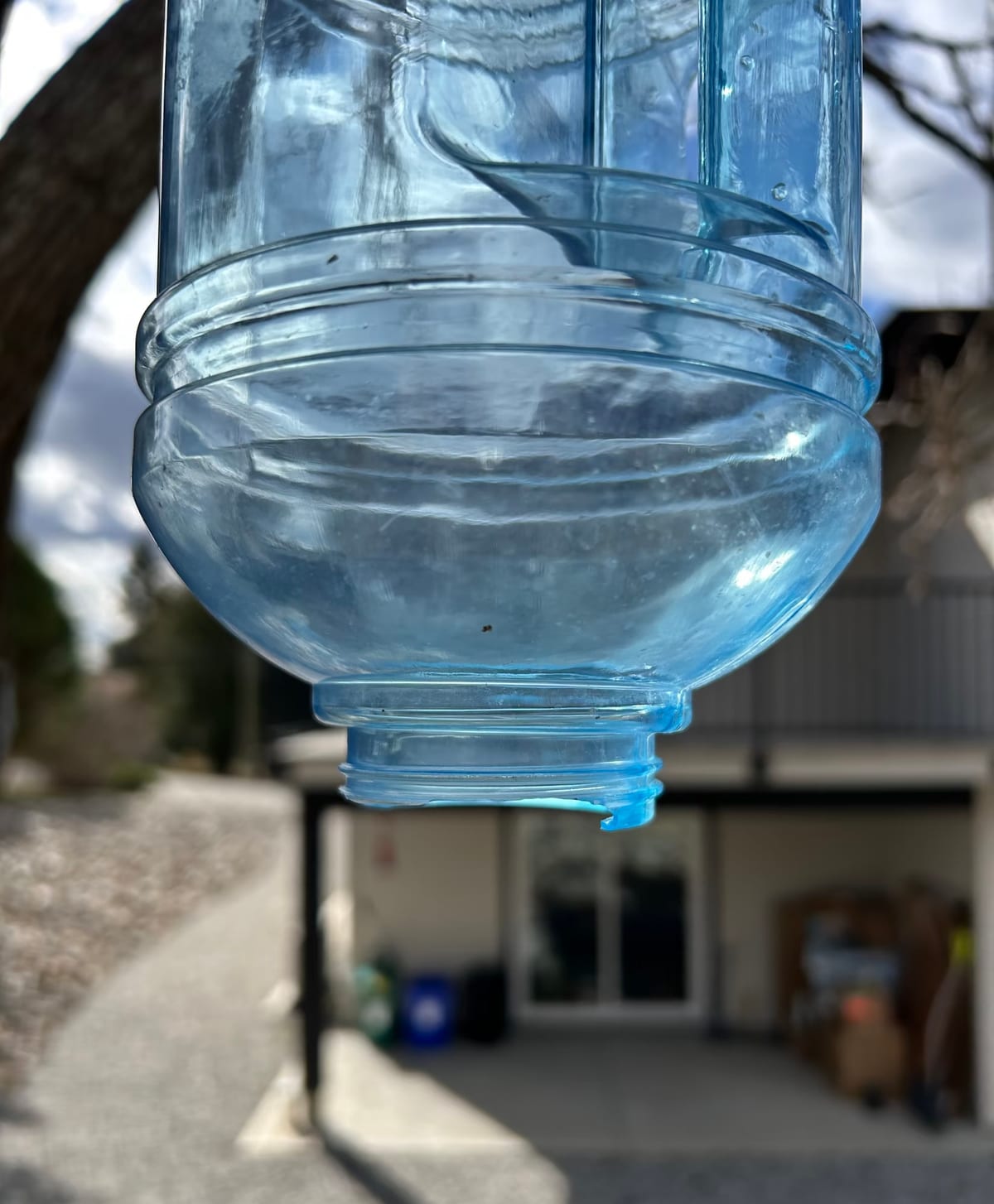
It also solves the discovery problem, which is the usual reason a new bath sits empty. Penn State describes the low-cost version: A dripper adds water slowly to a bird bath from above, creating the sound of water dropping into the bath, and notes you can make one from a punctured plastic bottle hung above the basin.
Moving water is not a substitute for changing it. A pump recirculates the same water, algae and all.
Why a dirty bath is worse than no bath
Because a bath concentrates birds at a shared wet surface, which is the same mechanism that makes feeders a disease risk.
Audubon lists what circulates: With more birds crowding at your bath during migration, there's a higher chance of viruses being spread, including house finch eye disease, salmonellosis, and avian pox. The article attributes the seasonal risk to John Wenzel, entomologist and director of the Powdermill Nature Reserve, who identifies fall as an especially high-risk season for disease.
Two of those names should be familiar. Salmonellosis and house finch eye disease are the same conditions that turn up at seed feeders, and the response when you find a sick or dead bird is the same as it is there: take the thing down and clean it, rather than adjusting the schedule.
An unmaintained bath is not a neutral object. It is a shared drinking vessel that nobody washes.
How to keep a bird bath clean: where the two sources disagree
| Question | Audubon | Penn State Extension |
|---|---|---|
| Water change | Every other day | Every day, ideally |
| Cleaning agent | Vinegar, 1 part to 9 water. No synthetic soaps, they strip feather oils | Brush, mild soap, and water, weekly |
| Position vs feeders | Close to, but not directly under | Not underneath feeders |
| Cover | Near woody brush | Near shrubs or low branches, but 10-15 feet of open ground for ground baths |
| Moving water | Recommended against mosquitoes | Dripper or mister recommended to attract birds |
| Depth | Not stated on this page | Two to three inches maximum |
Questions people ask
How deep should a bird bath be? No more than two to three inches at the deepest point, per Penn State Extension. Shallower at the edges, and rough enough underfoot that a wet bird can grip.
How often should I change the water in a bird bath? Every other day according to Audubon, daily according to Penn State. In hot weather the daily version is the one that prevents mosquito larvae from developing.
How do I get rid of algae in a bird bath? Scrub weekly with a brush. Audubon recommends a nine to one water and vinegar solution and advises against synthetic soaps; Penn State recommends mild soap. Moving the bath into shade reduces how fast algae returns.
Can I use bleach in a bird bath? Neither source we cite recommends bleach for routine bird bath cleaning. Audubon's routine is vinegar, Penn State's is mild soap, and both are weekly rather than harsh.
Will a bird bath breed mosquitoes? It can if the water sits. Changing it daily in summer prevents larvae from hatching, and moving water discourages egg laying in the first place.
Where should I put a bird bath? Near cover so birds can escape, in shade to slow algae, and never directly under a feeder. Ground-level baths need more open space around them because of cats.
Do birds need a bird bath in summer? Water is used for drinking as well as bathing, and it matters most when it is hot and when natural sources dry up. The winter version of this question, when water is frozen rather than scarce, is a different problem with different hardware.
How to keep a bird bath clean: the short version
Shallow, rough, shaded, and not under the feeder. Two to three inches at the deepest, changed every other day and daily when it is hot, scrubbed once a week with a brush.
On what goes on that brush, two respectable sources tell you opposite things, and the honest position is that the weekly scrub is doing most of the work either way.
So go and put a finger on the bottom of the basin. If it is slick, the water has been standing longer than it should, and that is worth more than any product on the shelf. How to keep a bird bath clean is settled by how often you change it, not by what you scrub it with.
This article contains no affiliate links. The photograph was taken by our contributor Kevin Hu and is used with permission. More on where our photographs come from.