
Cats and Bird Feeders: What You Can Actually Control
Cats and bird feeders: a feeder gives a cat a fixed address. What the research says, and the placement and collar evidence that changes the odds.
Cats and bird feeders is a question about geography rather than about cats. A feeder does not attract them. What it does is give them a fixed address: the same spot, several times a day, with distracted birds arriving and leaving.
That is the part of this you built, and it is the part you can change. This article is about the feeder, not about how anyone should keep their cat.
How many birds do cats actually kill?
The number people quote comes from one study, and it is worth quoting precisely.
Loss, Will and Marra, writing in Nature Communications in 2013, conducted a systematic review and concluded: We estimate that free-ranging domestic cats kill 1.3-4.0 billion birds and 6.3-22.3 billion mammals annually.
They put that in context of what came before, describing earlier figures as unreliable: The magnitude of mortality they cause in mainland areas remains speculative, with large-scale estimates based on non-systematic analyses and little consideration of scientific data.
And their conclusion about scale: free-ranging cats are likely the single greatest source of anthropogenic mortality for US birds and mammals.
One detail almost never travels with that number. The figures were corrected after publication. The journal's corrigendum explains why: The original version of this Article contained incorrect estimates of the number of animals killed by free-ranging domestic cats, which were based on 90% confidence levels rather than the stated 95% confidence levels. Recomputing at the stated level widened the range, so the bird estimate moved from 1.4-3.7 billion to 1.3-4.0 billion.
The authors also state what the correction did not do: The original conclusions are not affected by any of the above changes.
So the figure is sound, and it has been through a public revision that widened the uncertainty instead of narrowing it. Anyone citing "1.4 to 3.7 billion" is quoting the superseded version.
Is your cat the problem?
Statistically, probably not the main part of it, and the paper itself says so: Un-owned cats, as opposed to owned pets, cause the majority of this mortality.
That is worth stating plainly because the subject usually arrives as an accusation, and the accusation is aimed at the wrong population. Strays and feral colonies do most of it.
It does not make an owned cat's share zero. It does mean the honest framing for a bird-feeding household is narrower than the headline: your cat is a small part of a very large number, and it is the part you have any say over.
What does a feeder actually change?
Three things, and all three are yours.
Concentration. Birds that would be spread across a neighborhood are now arriving at one point.
Predictability. A hunting animal does not need to search when the food source has an address and a schedule.
Distraction. A bird at a feeder is doing something other than watching the ground, and a bird leaving one is often leaving in a hurry, which is the same mechanism that makes glass a hazard near feeders.
None of that means the feeder is a mistake. It means the feeder decides where the encounter happens, and where is something you choose.
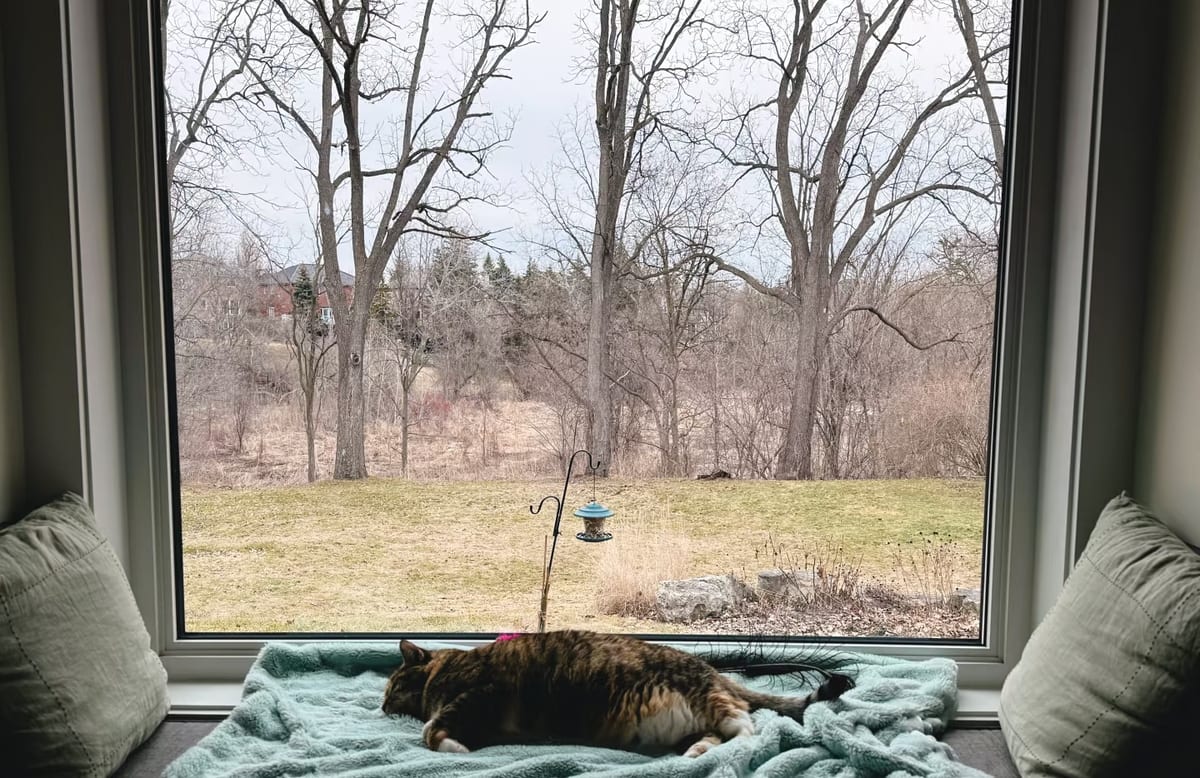
How to keep cats away from bird feeders: use placement
Away from cover, and off the ground.
Project FeederWatch's placement rule covers cats in the same breath as squirrels, warning against positions close to jump-off points for squirrels and cats. The ten-foot clearance most people apply for squirrels is doing double duty, and the full set of trade-offs is in where to put a bird feeder.
The thing to look for is not distance in the abstract. It is whether an animal can get within a body length of the feeding area without being visible. A low wall, a dense shrub, a woodpile, or long grass at the base of a pole all provide that.
The same reasoning governs water. A bathing bird is a wet bird, and a ground-level basin sets up the identical ambush, which is why where a bird bath goes follows the same open-ground rule.
Ground feeding is the case where this matters most. Seed scattered on the ground puts birds at cat height, in the open, without a perch to bolt to. That trick is often recommended to make a new feeder more visible, and it is genuinely useful in the first weeks after you hang one. If cats visit your yard, it is the one recommendation on this site to skip.
Do bells on cats stop them catching birds?
Bells and collar covers are two different interventions, and only one of them has good evidence behind it.
The folk answer is a bell. The thing that has been tested in peer-reviewed trials is a high-visibility collar cover, sold as Birdsbesafe, and it works through sight instead of sound. The trial's own description: The vivid colours of the Birdsbesafe® collar cover are assumed to alert nearby birds to the cat's presence, allowing them to escape safely.
The result, from Pemberton 2020 in the Journal of Zoology: Overall, 19 cats were trialled over 8 weeks and the Birdsbesafe® collar cover resulted in a reduction of 78% in the number of birds killed.
Three limits belong with that number, and we would rather give them than not.
Nineteen cats over eight weeks is a small trial. Studies of this kind count prey brought home, which is not the same as prey killed, so the underlying rate is measured indirectly. And the authors name an open question themselves: Further research is required into owner attitudes to collars in order to examine whether these collar-based devices could be widely adopted.
We have not tested this product and are not scoring or recommending it. We are naming it because it is what the study tested, and a vague reference to "brightly colored collars" would be less useful to anyone who wanted to check the research.
On bells specifically: we did not find a comparable body of evidence, so this article does not tell you they work or that they do not.
What actually moves the odds
| Measure | Evidence | Can you do it? |
|---|---|---|
| Feeder away from cover and jump-off points | FeederWatch placement guidance | Yes, and it is free |
| Not scattering seed on the ground | Follows from the above | Yes |
| High-visibility collar cover | 78% reduction in one 19-cat trial | Only for your own cat |
| Bell on the collar | No comparable evidence found | Unclear whether worth doing |
| Keeping a cat indoors | Removes the household's contribution | The owner's decision, not ours |
What if it is not your cat?
This is the common version of the problem and the one nobody writes about, probably because there is no satisfying answer.
You cannot fit a collar to a neighbor's cat. What remains is everything on your side of the fence: move the feeder into the open, stop ground feeding, clear the cover that lets an animal approach unseen, and accept that a yard adjoining other yards is not a controlled environment.
Local rules are worth knowing before a conversation starts. Cat containment is regulated in some places and not in others, and it sits in the same patchwork of municipal codes as the ordinances that govern feeding. Checking what your city actually says is more useful than assuming either that you have no standing or that you have a case.
What this article is not going to do
It is not going to tell you how to keep your cat.
Indoor and outdoor cat ownership is argued fiercely, the arguments involve the cat's welfare as well as the birds', and this is a site about bird feeders. What we can say is what the research says and what the equipment can do. The rest is a household decision that does not get better for our having an opinion about it.
The one thing we will say plainly is that the placement advice is not a substitute for anything. It reduces the opportunity your feeder creates. It does not make a yard safe.
Questions people ask
Do bird feeders attract cats? Not directly. A feeder concentrates birds at a fixed, predictable location, which is the condition an ambush predator needs. The cats were already there.
How many birds do cats kill in the US? Between 1.3 and 4.0 billion a year, per Loss, Will and Marra in Nature Communications. That is the corrected figure; the original paper gave 1.4 to 3.7 billion before a published corrigendum widened the range.
Are pet cats or stray cats responsible for most of it? Un-owned cats, according to the same study.
Do collar covers reduce bird kills? One peer-reviewed trial of 19 cats over eight weeks found a 78% reduction in birds killed with a Birdsbesafe collar cover. It is a small trial and it counts prey brought home rather than prey killed.
Do bells on cat collars work? We did not find peer-reviewed evidence comparable to the collar cover trials, so this site does not claim either way.
What do I do about a neighbor's cat at my bird feeder? By changing your own yard: feeder in the open, away from jump-off points, no seed scattered on the ground, and no dense cover within a short dash of the feeding area.
Cats and bird feeders: the short version
The research figure is large, it has been publicly corrected in a way that widened rather than narrowed it, and the majority of the mortality is attributed to cats nobody owns.
Your feeder does not add a cat to the neighborhood. It sets an address and a timetable, and that is the piece you can move. Placement away from cover does more than anything else available to you, and it costs nothing.
So go and crouch beside the feeder, at cat height, and look at what is within one short dash of it. If something there would hide an animal until the last second, that is the thing to deal with, and no collar or opinion about cat ownership will do it for you. Cats and bird feeders can share a yard, but only if the distances are decided on purpose.
The photograph in this article was taken by our contributor yuanyuan and is used with permission. More on where our photographs come from.