
How to Attract Woodpeckers: Two of Them, Not All of Them
How to attract woodpeckers depends on the species. Audubon names backyard feeders for two of them and describes dead wood and stored nuts for the others.
How to attract woodpeckers has a different answer depending on which woodpecker you mean, and most advice on the subject does not say so. Two of the common backyard species are described by Audubon as feeder birds. Two others are described entirely in terms of dead wood, carpenter ants and stored acorns.
That difference decides whether your problem is a shopping problem or a habitat problem, and no amount of suet solves the second one.
How to attract woodpeckers: start with which one
The species pages are unusually clear about this, and reading four of them side by side is more useful than any general guide.
| Species | What Audubon's account says about feeders | So the lever is |
|---|---|---|
| Downy | Will eat suet at bird feeders | Suet |
| Red-bellied | Has been known to be attracted to suet feeders | Suet |
| Pileated | Feeders are not mentioned in its diet or foraging sections | Large trees and dead wood |
| Red-headed | Feeders are not mentioned in its diet or foraging sections | Dead trees, and nest-hole competition |
On that third column, we are describing what these pages do and do not contain, not claiming the birds never visit a feeder. Audubon's Downy and Red-bellied accounts name feeders directly. Its Pileated and Red-headed accounts describe foraging without reference to them. That is a difference in what is documented, and it lines up with what the same pages say those birds are doing instead.
Do woodpeckers eat from bird feeders?
Two of these four, on the record, and one of them is the most reliable suet visitor there is.
Audubon on the Downy: In the east this is the most familiar member of the family, readily entering towns and city parks, coming to backyard bird feeders, and then the specific line, Will eat suet at bird feeders.
The Red-bellied is a step less certain in the wording: Has been known to be attracted to suet feeders. Known to be attracted is not the same phrase as readily coming, and the difference is probably real.
Audubon's guide to suet visitors puts the family at the front of the queue overall, which is quoted in the next section alongside the rest of what reaches them.
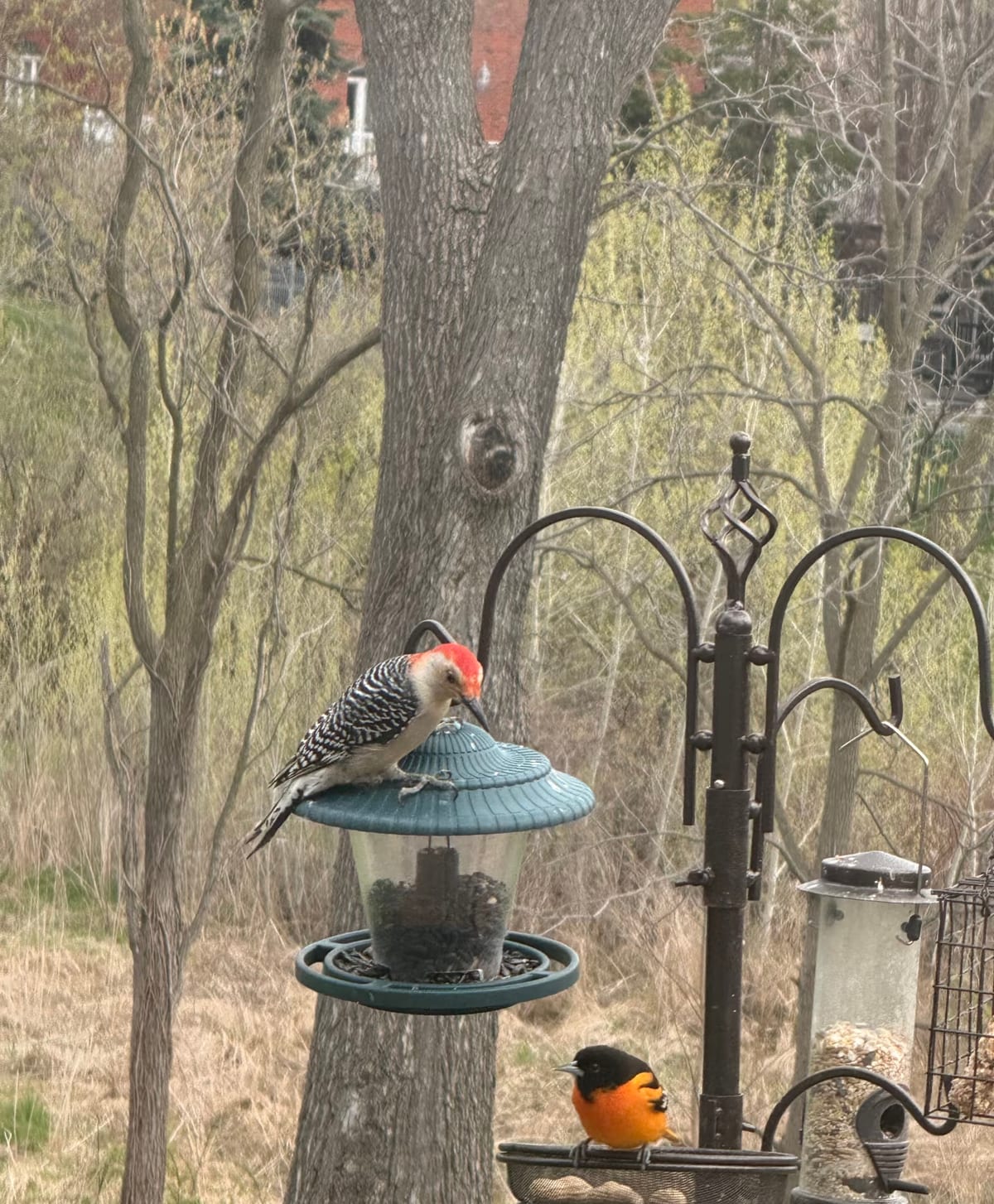
What to feed woodpeckers
Suet, peanuts, and not much else, with one species-sized exception at the end.
Suet is the first answer and the reliable one. Audubon names the audience directly: Suet (beef fat) attracts insect-eating birds such as woodpeckers, wrens, chickadees, nuthatches, and titmice. Among that group the family leads: Woodpeckers are some of the most frequent suet guests, and the Downy Woodpecker is probably the most frequent.
Peanuts are the second. The US Fish and Wildlife Service: Peanuts in the shell and peanut pieces are especially attractive to woodpeckers, jays, nuthatches, titmice and chickadees. That list is the same guest list suet reaches, which is worth knowing before you buy both.
Peanut butter works and is cheaper than either. Cornell's winter feeding notes pair it with suet as an equivalent: You can also attract insect-eating birds such as chickadees, woodpeckers, and nuthatches to your yard by offering peanut butter or suet (beef fat). The mixtures that keep it off feathers in warm weather are in suet for birds.
Sunflower is a bonus, not a draw. FeederWatch mentions woodpeckers only in passing on black-oil sunflower: Woodpeckers even consume these seeds on occasion. On occasion is doing the work in that sentence. A sunflower feeder is not a woodpecker strategy.
| Food | Reaches woodpeckers | Also reaches |
|---|---|---|
| Suet | Yes, most reliably | Wrens, chickadees, nuthatches, titmice |
| Peanuts | Yes | Jays, nuthatches, titmice, chickadees |
| Peanut butter | Yes | The same insect-eaters as suet |
| Black-oil sunflower | Occasionally | Nearly everything else |
And the exception. What food attracts pileated woodpeckers is the question this list cannot answer, because Carpenter ants may be up to 60% of the Pileated Woodpecker's diet and no feeder supplies those. The Red-headed Woodpecker is similarly self-sufficient in winter: it Gathers acorns, beechnuts, and other nuts in fall, storing them in holes and crevices, then feeding on them during winter. For both of those, food is not the lever, which is the whole point of the section above.
What kind of bird feeder is best for woodpeckers?
A suet cage, and the useful detail is which kind, which is settled elsewhere on this site rather than repeated here.
A cage open only at the bottom lets woodpeckers feed hanging upside down while excluding starlings, which filters by posture rather than by size. The FeederWatch wording and the rest of the reasoning are in what each feeder type decides.
What goes in it is covered in the section above. The caveats about what else peanuts draw are in what not to feed birds.
How to attract pileated woodpeckers
By having the right trees, and there is no substitute you can hang.
This is the largest woodpecker most people will ever see, and Audubon's account of it is a description of an animal that eats inside wood: Forages mainly by probing, prying, and excavating in dead wood in search of insects. The specificity of the diet is striking: Carpenter ants may be up to 60% of the Pileated Woodpecker's diet.
Sixty percent carpenter ants. A suet cage is not competing with that, and the bird's presence is decided by whether your area contains what carpenter ants live in.
The habitat requirement is a threshold rather than a preference. Audubon notes it will use second-growth and fragmented woodlots, as long as some large trees are present, and the nest site tells you the same thing in different words: a cavity in a dead tree or in dead branch of a live tree, sometimes in utility pole, usually 15-80 ft above ground.
So the honest answer to this query is a question about your property, not your feeder. Large trees, standing dead wood, and fallen logs left where they fell. If none of that is available within reach, the seed aisle has nothing that changes the outcome.
How to attract red headed woodpeckers
This one is a conservation question, and it runs directly into a bird already discussed on this site.
Audubon calls the Red-headed Woodpecker perhaps the most omnivorous of woodpeckers, and describes a habit that explains why a feeder is beside the point for it: Gathers acorns, beechnuts, and other nuts in fall, storing them in holes and crevices, then feeding on them during winter. A bird that caches its own winter supply in autumn is not depending on what you put out in January.
The species has declined, and the reasons named are both about cavities: Reasons for decline not well known, probably include loss of potential nest sites (owing to cutting of dead trees), competition with starlings for nest cavities.
Competition with starlings for nest cavities. That is the same non-native species that turns up in what hole size keeps a starling out of a nest box, and the same one whose legal status differs from every native bird at your feeder, covered in what the law allows.
What helps this bird, on the evidence of that sentence, is leaving dead trees standing where it is safe to do so. That is an unpopular thing to recommend and it is what the source names first.
| If you want | Do this | Realistic? |
|---|---|---|
| Downy Woodpeckers | Suet in a bottom-access cage | Yes, in most eastern yards |
| Red-bellied Woodpeckers | The same suet setup | Yes, within its range |
| Pileated Woodpeckers | Keep large trees and dead wood | Only if the habitat is already there |
| Red-headed Woodpeckers | Leave dead trees standing | A landscape decision, not a feeder one |
How to feed woodpeckers without feeding everything else
Suet is a filter as well as a food, and it does most of the work for you.
Suet reaches insect eaters rather than seed eaters, which is why a suet cage brings woodpeckers, chickadees and nuthatches while the finches carry on ignoring it. The full account, including the recipes and the summer heat question, is in suet for birds.
The one thing worth adding here is that the cage geometry matters more for this family than for any other, because their normal feeding posture is vertical and clinging. A design that asks a bird to hang beneath the food is asking woodpeckers to do something they already do.
Questions people ask
Do woodpeckers eat from bird feeders? Downy and Red-bellied Woodpeckers do, on Audubon's account, and suet is the food named for both. Pileated and Red-headed Woodpeckers are described in terms of dead wood and stored nuts instead.
What is the best feeder for woodpeckers? A suet cage, ideally one accessible only from the bottom, which admits woodpeckers and nuthatches while excluding starlings.
How do I attract pileated woodpeckers? Mostly you do not, unless the habitat is present. Carpenter ants can be up to 60 percent of the diet, and the bird needs large trees and dead wood rather than a feeder.
How do I attract red-headed woodpeckers? Standing dead trees. Audubon lists loss of nest sites from cutting dead trees, and competition with starlings for cavities, among the likely reasons for the decline.
Will peanuts attract woodpeckers? Yes. US Fish and Wildlife lists peanuts in the shell and peanut pieces as especially attractive to woodpeckers, along with jays, nuthatches, titmice and chickadees.
Do woodpeckers come to feeders in summer? Yes, though suet needs different handling in heat, which is covered in the suet article.
Why is a woodpecker drilling on my house? That is a separate behavior from feeding, and drumming on a resonant surface is part of how these birds advertise territory rather than a sign they are hungry.
What do woodpeckers like to eat? Suet first, then peanuts, then peanut butter, on the word of Audubon, the US Fish and Wildlife Service, and the Cornell Lab respectively. Black-oil sunflower reaches them only on occasion, in FeederWatch's wording, so a sunflower feeder is not a woodpecker strategy. The table above shows which other birds each of those foods brings with it.
What food attracts pileated woodpeckers? Nothing that goes in a feeder. Audubon puts carpenter ants at up to 60 percent of the Pileated Woodpecker's diet and describes it foraging by excavating dead wood for them. Large trees, standing dead wood, and fallen logs are what bring the bird in, and the seed aisle does not change that.
How to attract woodpeckers: the short version
How to attract woodpeckers splits cleanly in two. For Downy and Red-bellied Woodpeckers it is a purchase: suet, in a cage open at the bottom, hung where the birds can approach it vertically. Most yards in the eastern United States can do this today.
For Pileated and Red-headed Woodpeckers it is not a purchase at all. One needs large trees and rotting wood full of carpenter ants; the other needs standing dead trees that nobody has cut down, and it is losing those to tidiness and to starlings taking the cavities.
The reason this distinction matters is that the second group is where the advice usually goes wrong. A page that answers all four species with the same suet cage has told three quarters of its readers something that will not work, and the tell is that it never names which woodpecker it means. How to attract woodpeckers has two answers, and the page that gives one has answered the wrong reader.
There is a version of this that arrives uninvited. The same Downy that works a suet cage will also work grooved plywood siding, for reasons that have nothing to do with your feeder, and the holes it leaves can be read.
This article contains no affiliate links. Where this article says a source does not mention feeders, that is a statement about those pages, not a claim that the bird never visits one. Nothing here is a first-hand sighting: every claim about woodpecker behavior is attributed to the source that published it. The photograph was taken by our contributor yuanyuan and is used with permission.