
How to Get Rid of Grackles at a Feeder, and What the Law Allows
How to get rid of grackles at a feeder: why the flock is usually seasonal, which levers actually work, and the federal rule most advice never mentions.
How to get rid of grackles is the wrong shape of question, and the useful version is narrower: how to make your feeding station inconvenient for a flock while it is passing through. Most of these flocks are seasonal and leave on their own.
Three things decide the outcome: what is on the ground, what is in the feeder, and what the feeder makes a bird do to reach the seed. There is also a fourth thing, which is that some of the advice circulating for this problem describes a federally regulated act.
How to get rid of grackles: what actually moves them along
Nothing you buy will remove grackles from your yard. What you can do is stop being the easiest stop on their route, and that works because the flock is choosing between many yards.
Start with the calendar, because it may be doing the work for you. Audubon's account of the species is a description of a bird that travels: Big flocks are often seen flying overhead in the evening, heading for major communal roosts, especially from late summer through winter. It is also a bird that may not be a permanent resident where you are: The Common Grackle migrates in flocks during the day and is a partial migrant; present all year in much of its eastern United States range.
Which is why grackles hogging bird feeder space in September is a different problem from the same thing in June. Audubon puts the northern timing this way: In the North, migration is quite early in spring and fairly late in fall. A flock that arrives during a migration window is a flock with somewhere to be.
The behavior that makes them overwhelming when they do arrive is the same one: When not nesting, the Common Grackle usually forages in flocks. You are not being visited by a grackle. You are being visited by the flock that grackle is part of, which is why the feeder empties at a rate that feels personal.
Are grackles ground feeders?
Largely yes, and it tells you where your leverage is.
Audubon describes the foraging style plainly: Forages mostly by walking on ground or wading in very shallow water; also up in trees and shrubs. The same account confirms they use feeders too: Will come to feeders for various grain or seed items.
So a yard with seed scattered under the feeder is offering grackles their preferred arrangement, and a hanging feeder is the secondary target rather than the main one. That reorders the fixes:
Clear the ground first. Take up the platform tray if you have one, stop hand-scattering seed, and clean up what falls. The catch tray that reduces what sprouts and what rots underneath does the same job here, by keeping spill off the soil where a walking bird can work it over.
Then look at the feeder. A flock that cannot forage on the ground is a flock deciding whether your one feeder is worth queueing for.
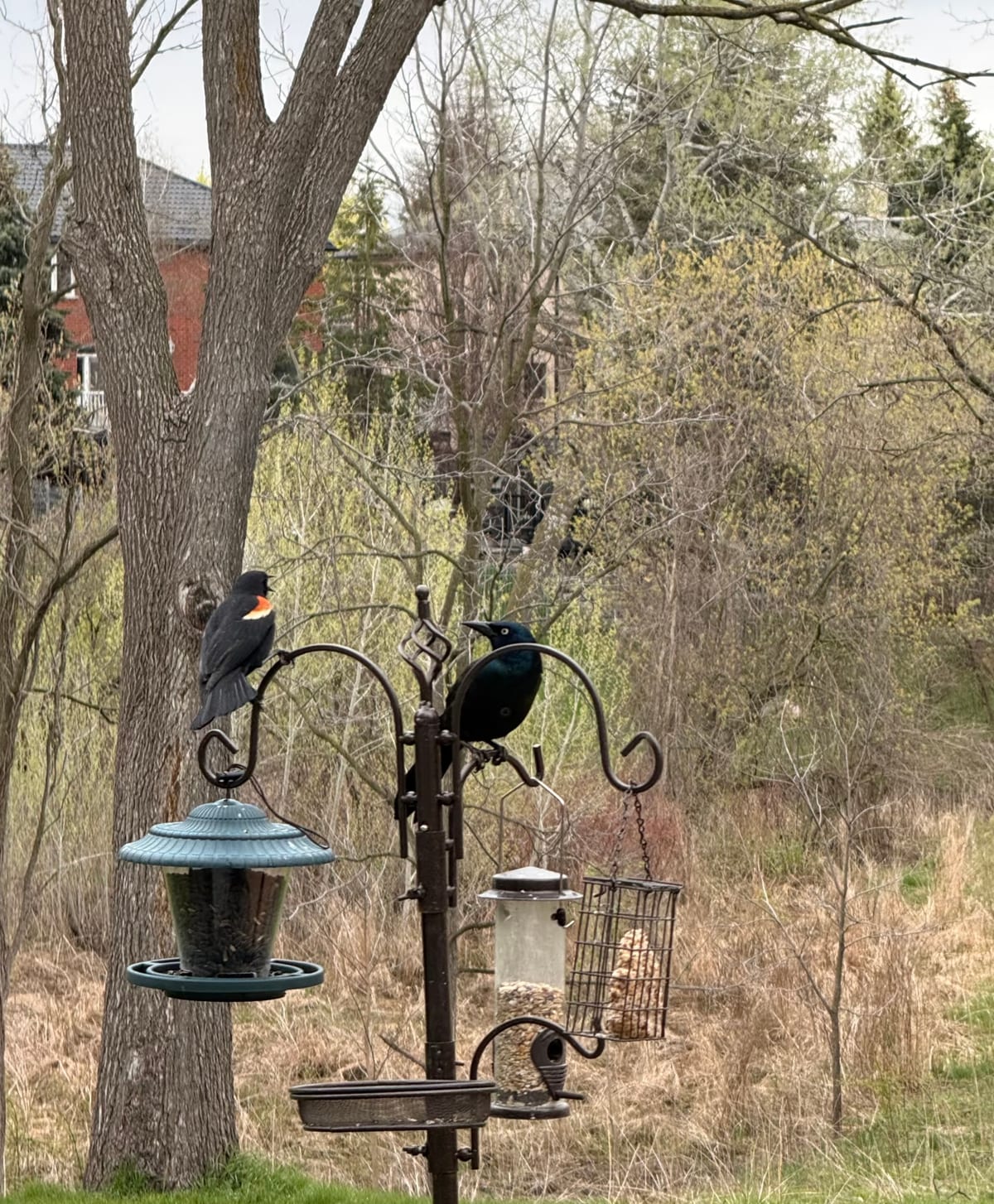
What bird food do grackles not like?
The internet is more confident about this than its sources are.
Safflower is the seed always named for this. What is documented about safflower is real but narrower than the claim: Audubon reports that squirrels dislike the taste and will generally avoid it, and Project FeederWatch notes that most birds prefer sunflower seeds over safflower. The full trade, including what you give up in general bird traffic, is in the safflower section of the squirrel article.
What we could not find is a source connecting safflower to grackles specifically. Cornell's food-type pages and Audubon's squirrel guide, which are the two places you would expect it, do not mention grackles at all in that context.
That does not mean safflower fails against grackles. It means the popular version of the claim is running ahead of what the two institutions that publish on feeder seed actually say, and if you switch, you should treat it as an experiment rather than a solution. Cheap mixed seed is a separate matter and worth removing regardless, because the grain fraction is what ground-feeding flocks work through fastest.
A bird feeder to keep blackbirds away, in one paragraph
The hardware answer is real, and it is already written down elsewhere on this site, so it gets a link rather than a repeat. Perch length and hopper size decide whether a large bird can stand where the seed is, and a cage open only at the bottom filters by feeding posture instead of by size. All of it, with the FeederWatch wording, is in what each bird feeder type is actually deciding.
A feeder that excludes grackles excludes cardinals and jays too. Exclusion by size does not distinguish between the large birds you like and the large birds you do not.
How do I get rid of starlings at my bird feeders?
Same complaint, different bird, and the difference matters more than it looks.
European Starlings are not native to North America and do not have the legal protection that grackles and blackbirds have. NestWatch states it directly: Because House Sparrows and European Starlings are exotic species, they are not protected by the Migratory Bird Treaty Act.
That is the same distinction that decides what you may do about a bird that takes over a nest box, and it is worth knowing before you act on any advice that treats all black birds at a feeder as one category. They are two categories, and only one of them is regulated.
At the feeder itself, the starling answer is more mechanical than the grackle answer, because starlings are defeated by posture rather than by size. That is the bottom-access suet cage, covered in the same feeder-types article.
What the law actually allows
The advice you find online divides into things that are fine and things that are not, and almost none of it says which is which.
Grackles, blackbirds and cowbirds are native and federally protected. There is a standing rule that carves out exceptions, and the exceptions are specific. The regulation is titled Depredation order for blackbirds, cowbirds, crows, grackles, and magpies, and it lists the covered species by name, including Common, Boat-tailed and Great-tailed Grackles, Red-winged and Brewer's Blackbirds, and Brown-headed Cowbirds.
For a backyard, what counts is the list of circumstances in which a private citizen needs no federal permit. There are five, and they are narrow:
| The rule allows control | Does a feeder situation fit? |
|---|---|
| Where they are causing serious injuries to agricultural or horticultural crops or to livestock feed | Agricultural damage, not a bird feeder |
| When they cause a health hazard or structural property damage | A large roost can raise this; a flock at a feeder does not |
| To protect a federally listed endangered, threatened or candidate species | Rare in a backyard |
| To protect a listed species in designated critical habitat | Rare in a backyard |
| To protect a species listed by a State or Tribe | Rare in a backyard |
Eating your birdseed is not on that list, and a feeder is not livestock feed.
There is also a condition attached to all of it that is easy to miss and applies every year: Each calendar year, you must attempt to control depredation by species listed under this depredation order using nonlethal methods before you may use lethal control. Nonlethal first is not a recommendation in that sentence. It is a precondition.
What this means in practice. Taking the feeder down for two weeks, removing ground seed, and changing the hardware are all unregulated and are the actual answer for a feeder. The measures people reach for when frustrated are the ones the order governs, and the order does not treat a backyard feeder as a qualifying circumstance.
This is federal law and it is only one layer. Your city may have its own rules about feeding wildlife, which is a separate question covered in whether feeding birds is legal where you live. We are describing what the federal depredation order says, not giving legal advice, and the regulation itself is one click away and short enough to read.
When it ends on its own
Often within weeks, and the timing depends on where you are.
A flock passing through on migration is following the pattern Audubon describes, moving toward communal roosts from late summer onward. In much of the eastern United States, though, grackles are present all year, so a resident population is a different situation from a migrant flock, and only the second one solves itself.
The practical test is simple: note the date the flock arrived and whether the numbers are still climbing. A flock that grows for a few days, stays flat, and then thins out was passing. A steady group that persists across seasons is resident, and resident birds are managed with hardware and ground discipline rather than waited out.
Grackles displacing smaller birds is the visible end of something researchers have measured across tens of thousands of encounters, and where each species lands in that order is mostly a question of size.
| What you do | Effect on grackles | What it costs you |
|---|---|---|
| Remove ground and tray seed | Large, since they forage by walking | You lose juncos, doves and sparrows too |
| Take the feeder down for two weeks | Large while it lasts | Your regulars scatter and take time to return |
| Short-perch tube feeder only | Large | Cardinals and jays lose access as well |
| Switch to safflower | Unverified for grackles | Reduced interest from most birds |
| Bottom-access cage for suet | Large for starlings | Suet only, does not help at a seed feeder |
Questions people ask
How do I get rid of grackles at my bird feeder? Clear the ground first, since they forage mostly by walking. The same actions work on pigeons, and cost you the doves along with them. Then narrow the feeder so a large bird cannot perch. If the flock arrived recently, it may be migrating and will move on without any action.
Are grackles ground feeders? Mostly. Audubon describes them as foraging by walking on the ground, and also says they will come to feeders. Spilled seed underneath is the bigger draw of the two.
What bird food do grackles not like? Safflower is the usual answer, but we could not source that claim for grackles specifically. What is documented is that squirrels avoid safflower and that most birds prefer sunflower to it.
Is it legal to kill grackles at my feeder? Grackles are federally protected, and the depredation order that creates exceptions lists specific circumstances such as serious injury to agricultural crops or a health hazard. A feeder is not among them, and the order also requires that nonlethal methods be attempted first each calendar year.
Are starlings protected the same way? No. NestWatch states that House Sparrows and European Starlings are exotic species and are not protected by the Migratory Bird Treaty Act.
Will taking the feeder down work? For a passing flock, usually. Two weeks with nothing available moves a flock along, at the cost of dispersing the birds you wanted, which then take time to find the feeder again.
Do grackles hurt other birds? They dominate a feeding station by weight of numbers rather than by attacking, and the practical harm at a feeder is that smaller birds stop getting turns.
How to get rid of grackles: the short version
Grackles at a feeder are a flock problem, and flocks respond to what is on the ground more than to what is in the feeder. Clear the spill, take up the tray, and narrow the perches, in that order, and accept that everything which excludes a grackle also excludes a cardinal.
Then check the calendar before you spend money. Late summer through winter is when these birds gather and move toward communal roosts, and a flock that appeared this week may be gone before an order arrives.
The one thing worth reading in full is the federal depredation order, because it names the birds it covers by species and lists the five situations where a permit is not required. Look up which of those birds is actually in your yard. That name, not the color, is what decides everything that follows. How to get rid of grackles has a legal answer as well as a practical one, and the legal one is short enough to read.
This article contains no affiliate links and is not legal advice. The federal regulation is linked and quoted directly so you can read the current text yourself; local ordinances are separate and vary. Nothing here is a first-hand sighting: every claim about grackle behavior is attributed to the source that published it.