
How to Keep Squirrels Off Bird Feeders (and Why Most Fixes Only Buy Time)
How to keep squirrels off bird feeders: ten feet of clearance and a metal baffle set four to five feet up. Why seed tricks and thin plastic only buy time.
How to keep squirrels off bird feeders comes down to two measurements and one material. Put the feeder about ten feet from anything a squirrel can launch from, on a squirrel proof bird feeder pole rather than a branch. Fit a metal baffle on the pole, four to five feet off the ground: squirrel baffle placement is a measurement, not a matter of taste. Everything else on the usual list of tips, the seed tricks, the greased poles, the spinning gadgets, ranges from genuinely helpful to merely expensive, and none of it substitutes for those two distances.
The reason the geometry matters more than the gadget is that squirrels are not solving a puzzle. They are solving a jump.
What squirrels are actually good at
Audubon puts it in one sentence: They're very persistent, and they're very good at two things: climbing and jumping.
That pair is the whole problem. Blocking the climb without blocking the jump accomplishes nothing, because the squirrel simply arrives from the tree instead of the pole. Blocking the jump without blocking the climb accomplishes nothing either.
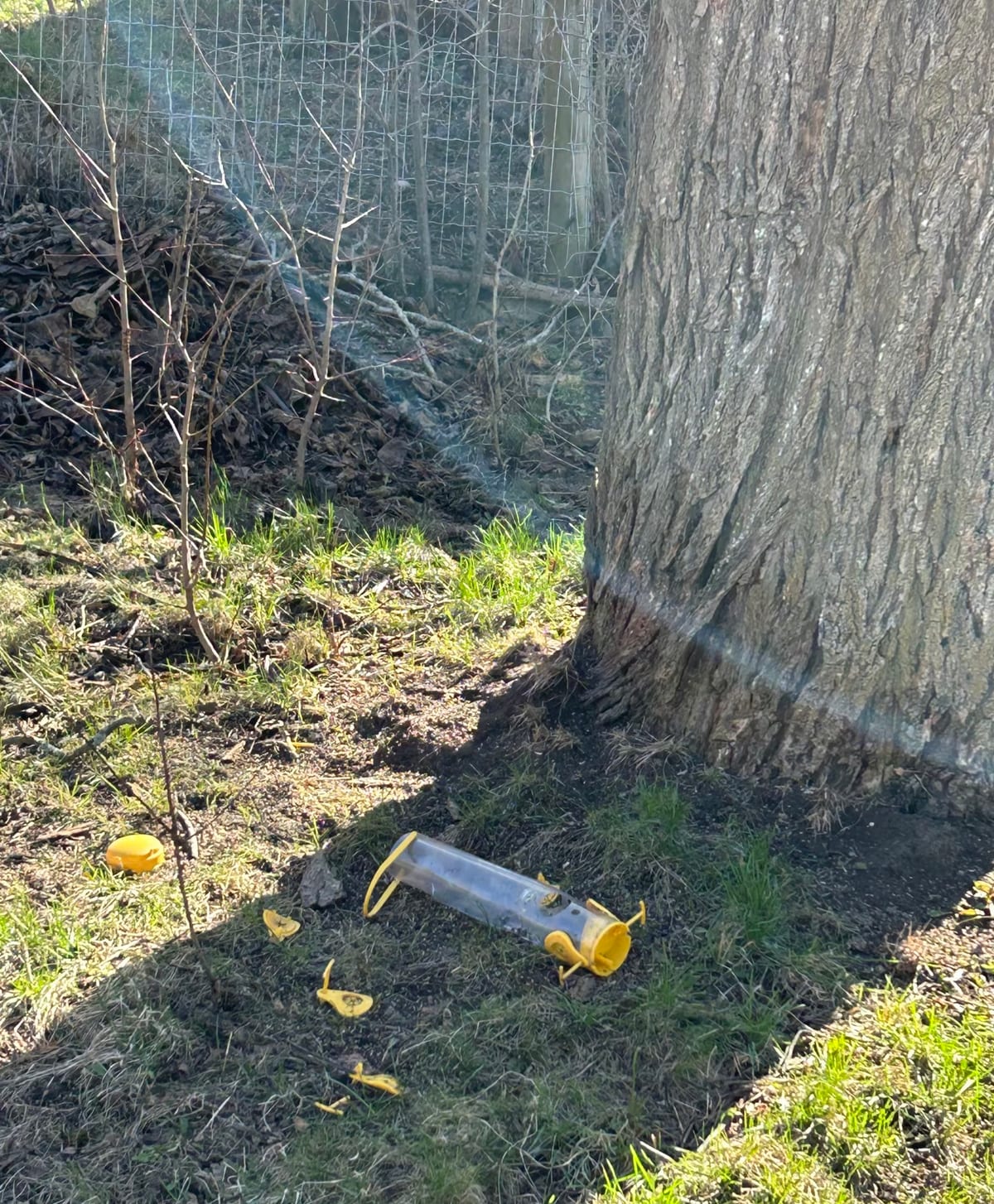
There is a third ability that gets less attention, and the photograph above is what it looks like. Given time at an unprotected plastic feeder, a squirrel does not need to solve access at all. It removes the container.
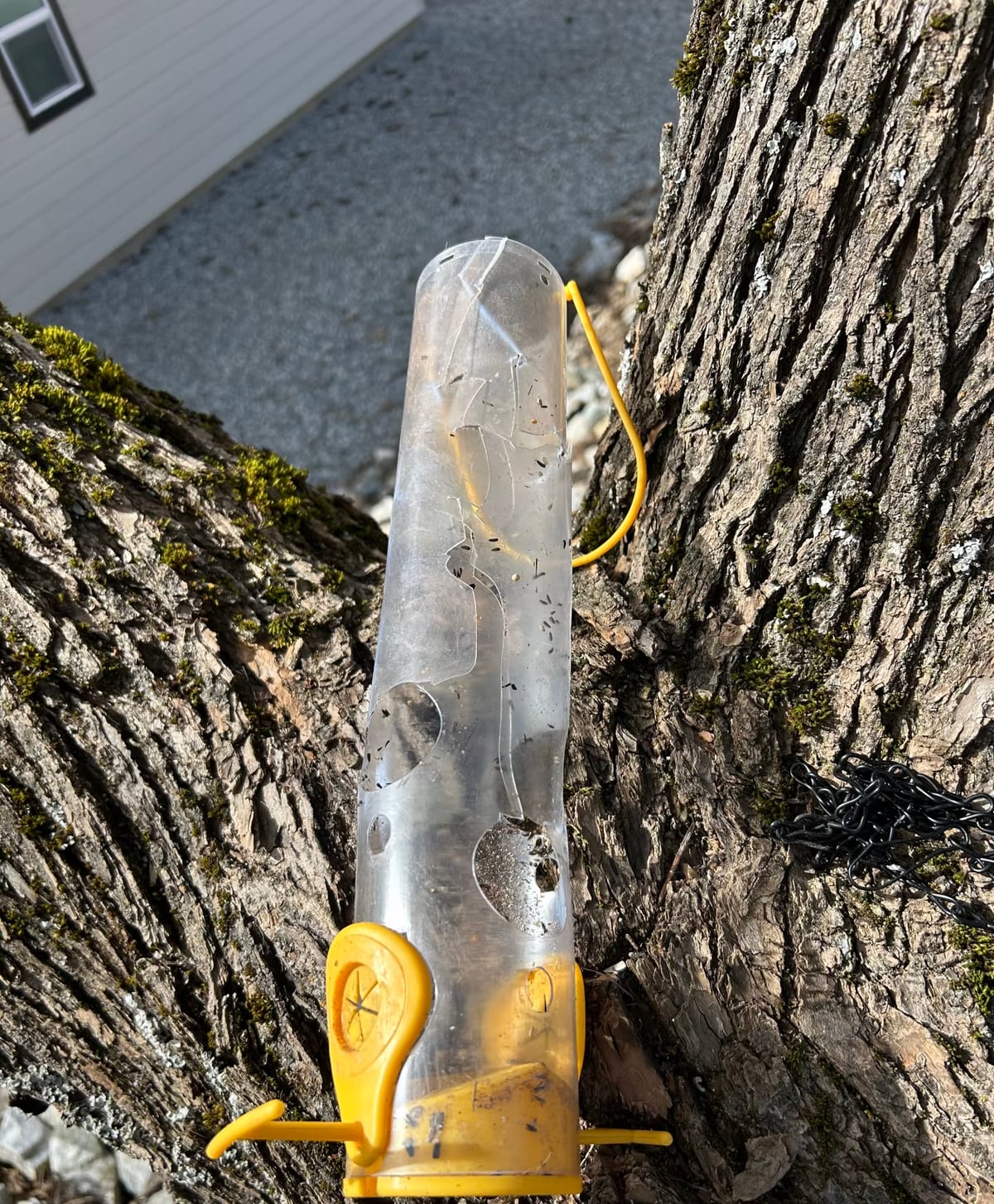
The same teeth do the same thing to a nest box, where an enlarged opening has a further cost: the hole diameter is the only thing keeping certain competitors out.
This is worth holding onto when you read feeder descriptions, because it reframes what a material specification means. Audubon's phrasing on baffles carries the point quietly: Baffles are devices ideally made from metal that, when properly installed, block squirrels from climbing up the pole to the feeder. The word doing the work there is metal.
Ten feet: the distance that keeps squirrels off bird feeders
Project FeederWatch gives the number plainly: However, squirrels can jump to feeders placed less than ten feet from a tree or building.
Ten feet of clearance from trees, walls, fences, railings, and rooflines. Audubon lands in the same range, advising eight to ten feet of separation from anything solid.
There is a genuine tension here, and FeederWatch names it rather than pretending it away. Birds want cover nearby: Place feeders close to natural cover, such as trees or shrubs, which offer refuge to birds as they wait their turn to feed. But that same cover is the launch pad. Their resolution is a compromise rather than a rule: Be careful not to place feeders too close to cover with strong branches that can provide good jump-off points for squirrels and cats. A distance of about 10 feet seems to be a good compromise. A deck railing is that jump-off point, which is why a railing mount starts at zero clearance.
Ten feet, in other words, is a negotiated distance: far enough from the branch, close enough to the shrub. And it is only one of three constraints on the same decision, since where a feeder sits relative to your windows carries higher stakes than anything a squirrel does.
This is also why hanging feeders from a tree limb is a structurally difficult position to defend.
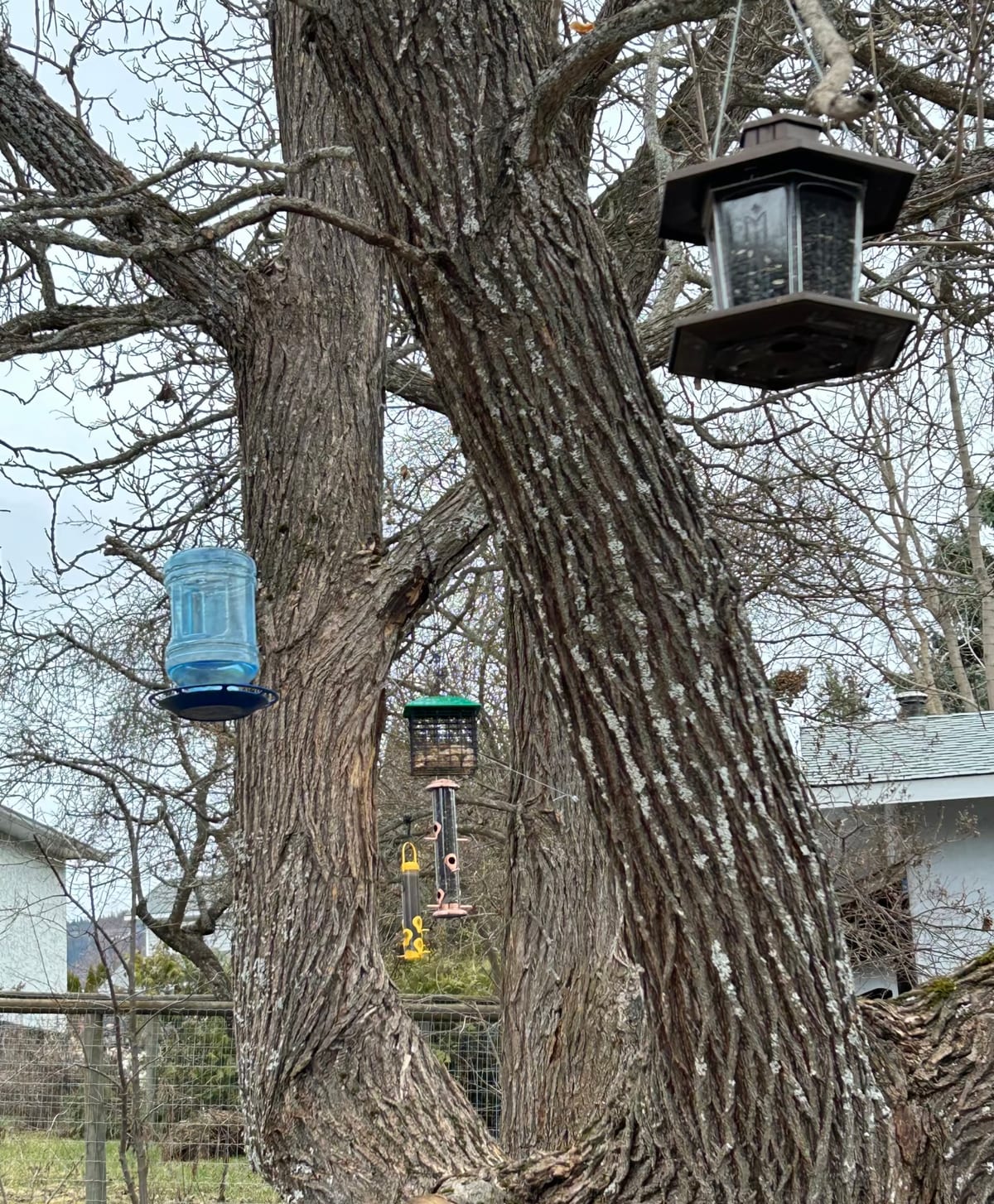
A tree gives you height, shade, and somewhere to hang things. It also puts every feeder within reach of an animal that lives in the tree. If the feeders stay in the tree, the defense has to shift to the feeders themselves, through cages, weight-activated ports, or a baffle above each one.
Baffles, and the height that keeps squirrels off the pole
FeederWatch is direct about the ranking: Squirrel baffles, or barriers placed between squirrels and feeders, are usually the best way to keep squirrels away from your seed.
A baffle below the feeder
For a pole, the baffle goes below the feeder: On pole-mounted feeders, baffles can be placed beneath the feeder to keep squirrels and other mammals from climbing the pole. Height is what makes it work, and Audubon gives the figure: the baffle needs to be between four and five feet off the ground. Mounted lower than that, a baffle just gives the squirrel a step up. The same hardware does double duty against rats, which have their own clearance numbers.
As an Amazon Associate, The Feeder Log earns from qualifying purchases. Links marked as such go to Amazon; we have not tested these products and link them as examples of the type the article describes.
Pole baffles come as a cone or as a steel cylinder, and a torpedo baffle is the usual name for the cylinder. The specification that matters is the mounting height above, not the brand or the shape.
A baffle above the feeder
For a feeder attacked from above, the geometry inverts. FeederWatch's version: If squirrels are jumping from above, a tilting baffle at least 18 inches in diameter placed above the feeder might work. Two details in that sentence are easy to skim past. Tilting, because a rigid dome is a platform. And at least 18 inches, because a smaller dome is something to reach around.
Note also that FeederWatch says it might work. That hedge is honest, and it is the difference between a source reporting what it knows and a product page selling certainty.
Weight-activated and caged feeders
Two feeder designs address the problem at the feeder rather than the pole.
Weight-activated ports
The first uses the animal's own mass against it. Audubon describes the mechanism: When a squirrel climbs onto one of these feeders, its body weight pulls down a shroud that blocks the feeding ports. Small birds are too light to trigger it, so the ports stay open for them.
The design Audubon is describing is the one most people picture when they hear the phrase, and a weight-activated feeder of that kind is the usual example. It is a moving part living outdoors, and the maintenance note in the table below applies to every model of it.
Cage feeders
The second is a physical exclusion: Another option is a feeder surrounded by a cage that keeps squirrels from reaching the food. Audubon states the trade in the next breath: The cage also keeps out larger birds. Cardinals, jays, and grackles lose access along with the squirrels, and whether that is a cost or a benefit depends on which birds you are feeding.
What the sources establish is that both mechanisms are real, and that a moving part on a feeder that lives outdoors in all weather is a maintenance question as much as a performance one. Which specific model holds up longest is not something this page can tell you, because nobody here has run one through a winter.
None of this changes if the feeder has a camera in it. Reviewers of smart bird feeders report the same squirrel and raccoon problem, and one manufacturer's setup guidance puts the feeder on a pole with a baffle for exactly this reason, which is one of the few points where the camera's requirements and the bird's agree.
Do squirrels eat safflower seed?
Partly, and the honest answer requires two sources rather than one.
Audubon reports that with safflower, squirrels dislike the taste and will generally avoid it. That is the half of the story you will find repeated everywhere.
The other half comes from FeederWatch, on the same seed: Safflower attracts cardinals and other big-billed birds. However, in our experience, most birds prefer sunflower seeds over safflower.
Put the two together and safflower stops looking like a trick and starts looking like a trade. You are accepting reduced interest from most of your birds in exchange for reduced interest from the squirrels. If cardinals are your main visitors, that trade is close to free. If you are feeding a broad mix, you are paying for the deterrent in bird traffic.
Worth keeping separate too from the version of this claim aimed at birds rather than squirrels, which we could not source for grackles. And worth keeping separate from the seed that gets refused for no reason at all: safflower is a deliberate choice, while the filler in a cheap mix is simply weight nobody selected.
Note as well that Audubon's wording is generally avoid, not will not eat. A squirrel with easier options elsewhere avoids safflower. A hungry squirrel with no alternatives is a different animal.
How to keep squirrels off bird feeders: every measure and what it does
The two measurements do the work and everything else is a supplement. Laid out together, it is easier to see which is which.
| Measure | What it blocks | Its limit | Source |
|---|---|---|---|
| About ten feet from any launch point | The jump | Does nothing about the climb | FeederWatch |
| Metal baffle on the pole, four to five feet up | The climb | Useless if mounted lower, and useless if the ten feet is missing | Audubon |
| Tilting baffle, at least 18 inches, above the feeder | Arrival from above | FeederWatch says it might work, and a rigid dome is a platform | FeederWatch |
| Weight-activated ports | Access, by using the animal's mass | A moving part living outdoors, so it is a maintenance item | Audubon |
| Cage around the feeder | Access, by exclusion | Excludes larger birds too | Audubon |
| Safflower seed | Interest, not access | Reduces appeal rather than preventing it | Audubon, with a caveat |
| Distraction feeding elsewhere | Some of the volume eaten | Does not stop a squirrel that visits anyway | FeederWatch |
| Thin plastic anything | Nothing | It gets chewed through, baffles included | The second photograph |
| Greasing the pole | Not worth doing at any effectiveness | Grease on feathers cannot be preened out | Humane World for Animals |
Read down the limit column and the pattern is that every single-measure fix has a way around it. That is why the two distances are described here as a system rather than a list.
What only buys time
Distraction feeding. FeederWatch offers it as a genuine option: One way to keep squirrels from consuming volumes of bird seed is to distract them by feeding peanuts or dried ears of corn in a location some distance from your feeders. It works on the same logic as safflower, by making the feeder the less attractive choice rather than an impossible one. It does not stop a squirrel that decides to visit anyway.
Thin plastic anything. Baffles included. See the second photograph.
Greasing the pole, which belongs in a stronger category than this one. It is listed among the tips at the top of this article as something that buys time, and there is a reason not to do it at all. Humane World for Animals: Don't grease up feeder poles or wires to prevent raccoons. If grease gets on a bird's feathers, they can't preen it out, leaving the bird vulnerable to predators, bad weather and disease. A bird that lands on a greased pole carries it into its plumage, so use a metal baffle instead. The same warning governs the mammals a squirrel baffle does not stop.
Placement without height, or height without placement. A baffle at ankle level on a pole ten feet from the tree fails. A perfectly positioned baffle four feet up a pole that stands three feet from a fence also fails. The two measurements are one system.
Questions people ask
How far should a bird feeder be from a tree? About ten feet, per Project FeederWatch, which is also the distance it recommends as a compromise between keeping birds near cover and keeping squirrels off the feeder.
How high should a squirrel baffle be? Between four and five feet off the ground on a pole, per Audubon, with the feeder itself above that.
Do squirrels chew through bird feeders? They chew through plastic ones, and the damage in the photographs above is what that looks like. Audubon's recommendation that baffles be made from metal reflects the same reality.
Will a cage feeder keep all the squirrels out? A cage sized to admit only small birds excludes squirrels, and it also excludes cardinals, jays, and other large-billed birds. If the cardinals are the point, keep one undefended surface for them. It solves one problem by narrowing the guest list.
Does hot pepper seed work? Neither of the sources used here addresses capsaicin-treated seed, so this article makes no claim about it.
How far can a squirrel jump to a bird feeder? Far enough that Project FeederWatch's clearance figure is ten feet from any tree or building. You will also meet a 5-7-9 rule on retailer sites, which Duncraft's version sets out as five feet from below, seven feet from nearby objects, and nine feet from above. That is a shop rule of thumb rather than a research figure; the numbers the research organizations publish are FeederWatch's ten feet of clearance and Audubon's four to five feet of baffle height.
How to keep squirrels off bird feeders: the short version
How to keep squirrels off bird feeders is mostly a question of geometry rather than gadgets: about ten feet of clearance from any launch point, and a metal baffle four to five feet up the pole beneath the feeder. Feeder-side designs such as weight-activated ports and cages address the problem from the other end, each with its own trade. Seed choices and distraction feeding shift the odds without closing the door. And a plastic feeder left undefended long enough stops being an access problem, because there is eventually nothing left to access.
Once the squirrels are handled, the feeder still needs cleaning on a schedule, which is the job that actually affects the birds' health. How to keep squirrels off bird feeders is a geometry problem, and geometry is the one part of it that stays solved.
Squirrels are also the one animal on the wider list of what a feeder attracts going after the feeder itself rather than what falls from it, which is exactly why the fix here is a measurement and not a cleanup routine.
The photographs in this article were taken by our contributor Kevin Hu and are used with permission. More on where our photographs come from.