
How to Attract Cardinals: The Bird Most Feeder Advice Excludes
How to attract cardinals: they hop and forage low rather than cling, so most squirrel-proofing and grackle-proofing shuts them out. What to do instead.
How to attract cardinals comes down to one physical fact that most feeder advice works against: a cardinal does not cling. It hops, and it feeds low, so the feeders sold to keep out squirrels and grackles keep out cardinals along with them.
Everything else is straightforward. They are already nearby if you are in their range, they eat the commonest seed in the aisle, and they do not leave for the winter.
How to attract cardinals: give them somewhere to stand
Audubon's description of the bird is, read closely, a description of what it needs from a feeder: The Northern Cardinal forages mostly while hopping on the ground or in low bushes, sometimes higher in trees.
Hopping is the operative word. A chickadee can hang off a short perch and take a seed; a cardinal wants a surface it can stand on with room for a bird of eight or nine inches. Audubon confirms the feeder part directly: Readily comes to bird feeders, where it favors sunflower seeds.
So the hardware answer is a hopper with a wide tray, a platform, or the ground itself. This is also why three separate problems on this site end with the same footnote about cardinals:
- A squirrel-excluding cage sized for small birds shuts out cardinals and jays too
- A short-perch tube, the standard grackle answer, gives a large bird nowhere to stand
- Clearing the ground to move a flock along, the main lever in what to do about grackles, removes the cardinal's preferred foraging surface
None of those are wrong. They simply have a cost, and the cost is usually this bird. If cardinals are what you want, run one feeder that is not defended and accept that it will be busy with everything else as well.
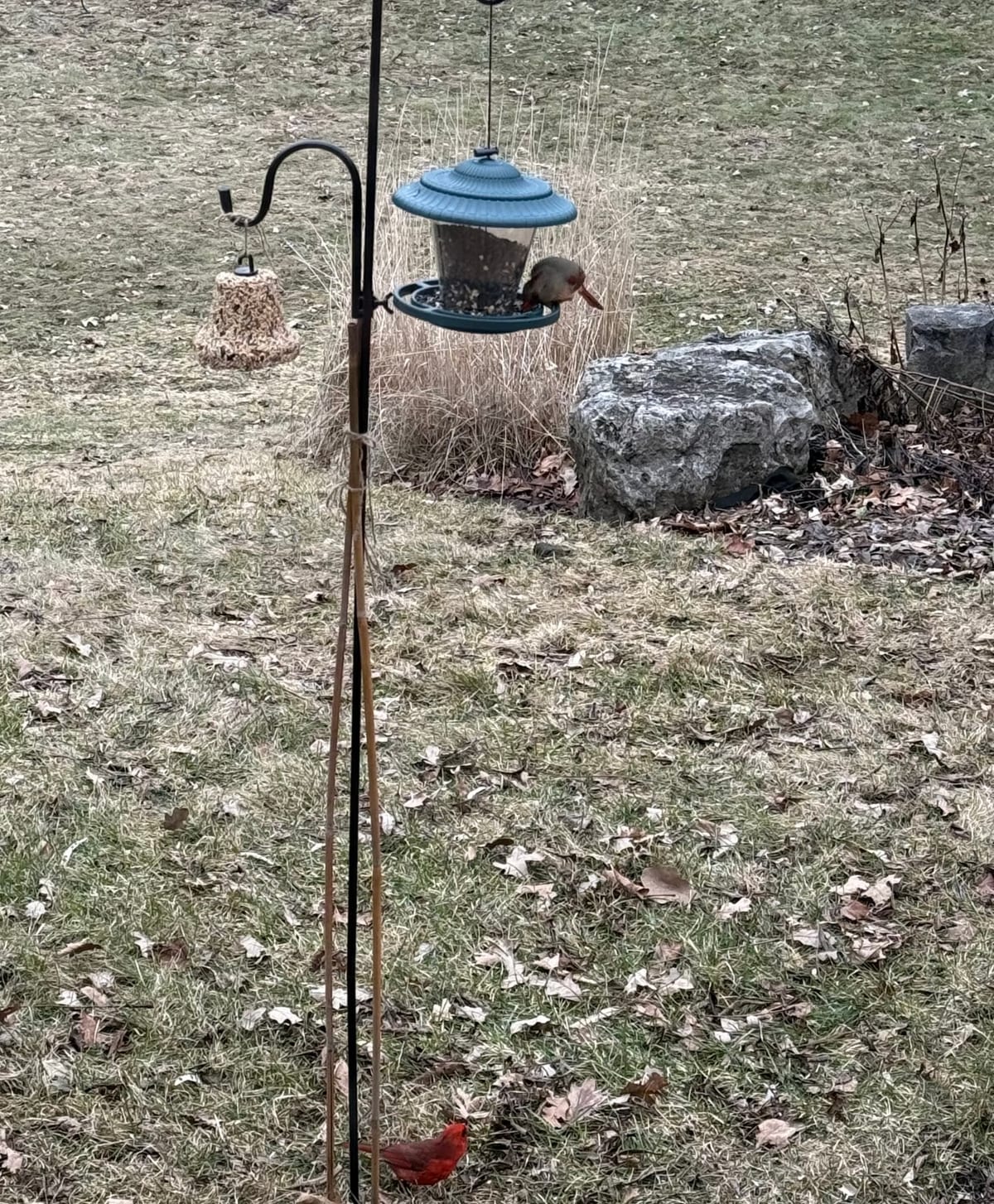
Bird seed to attract cardinals
Black-oil sunflower, and you probably already have it.
Audubon names sunflower as the preference, and Project FeederWatch puts cardinals at the front of the list for the same seed: Black-oil sunflower is among the favorite feeder foods of cardinals, chickadees, finches, and sparrows.
Safflower is the second answer, and it is worth knowing precisely what it is for. FeederWatch: Safflower attracts cardinals and other big-billed birds. However, in our experience, most birds prefer sunflower seeds over safflower. That sentence is doing two things. It confirms cardinals will take safflower, and it tells you most other birds would rather not, which is exactly why safflower gets recommended as a squirrel deterrent in the full version of that trade.
For a yard where cardinals are the target, that trade reads differently than it does for most people. You are not giving up much, because the bird you want is one of the few that likes the seed.
| If your goal is | Use | What it costs |
|---|---|---|
| Cardinals plus everything else | Black-oil sunflower, wide tray | Squirrels and grackles included |
| Cardinals with less competition | Safflower, wide tray | Reduced traffic from most other birds |
| Cardinals and small birds only | Two feeders, one open and one narrow | Two feeders to clean |
A bird feeder for cardinals but not blue jays
There is no clean way to do this by hardware, and it is worth saying plainly because the query implies there is.
Exclusion at a feeder works by size or by posture. Cardinals and Blue Jays are close enough in size that no perch length or cage gap separates them, and neither bird is asked to hang upside down. The mechanisms described in what each feeder type decides do not have a setting for this.
What you can change is the menu and the position, which is a weaker lever but a real one. The US Fish and Wildlife Service names the audience for the food jays come for: Peanuts in the shell and peanut pieces are especially attractive to woodpeckers, jays, nuthatches, titmice and chickadees, in the same guidance covered in what not to put out. Cardinals are not on that list. Leaving peanuts out of the yard removes a draw that is specifically for jays and takes nothing away from cardinals.
Our own reasoning, and labeled as such: a low feeder tucked against dense cover suits a bird that forages by hopping in low bushes better than it suits a bird that works in the open. We could not find a source that measures this, so treat it as a reasonable arrangement rather than a solution.
Where cover matters more than the feeder
Cardinals are a shrub bird, and the habitat requirement is stated as a near-absolute.
Audubon describes their range as a wide variety of brushy or semi-open habitats in the East, from forest clearings and swamps to city parks, almost wherever there are some dense bushes for nesting.
Almost wherever there are dense bushes. A yard with a lawn, a feeder pole and nothing else is missing the thing that decides whether these birds live there at all, and no seed choice compensates. The general version of that rule, and how close the cover should be, is in where to put a feeder.
What do cardinals eat besides seeds?
More than the feeder suggests, and the answer changes with the season.
Audubon: Most of diet is vegetable matter, including seeds of weeds and grasses, waste grain, leaf buds, flowers, and many berries and wild fruits. Insects are the other half of the picture, and they matter most at the one time of year when a feeder matters least: Young are fed mostly insects.
That is the honest limit of a feeder. Nesting cardinals are hunting caterpillars and beetles, not visiting your sunflower, and a yard with insects in it is doing more for them in June than a full hopper is.
Where do cardinals go in winter?
Nowhere. Audubon's range note is one line: Permanent resident throughout its range.
This makes cardinals the bird your winter feeding actually reaches, and it is a genuine argument for keeping a wide feeder stocked through the cold months rather than only during migration. The full case for winter feeding, including what the cold changes, is in feeding birds in winter.
There is a second consequence of being a permanent resident that surprises people in spring. Audubon: The male Northern Cardinals sing to defend nesting territory, actively attacking intruding males (and attacking their own reflection in windows and mirrors). If a cardinal is hitting your window repeatedly and not being hurt, that is territorial behavior rather than a collision, and it is a different problem with a different fix.
Feeding may have changed where cardinals live
Audubon states it carefully: Feeders stocked with sunflower seeds may have aided its northward spread.
The word is may, and we are leaving it there rather than upgrading it. But it is an unusual claim to find on a species page: the ordinary backyard habit of putting out sunflower seed is named as a possible factor in a bird's range expanding. Most of what a feeder does is small and local. This one is neither.
Questions people ask
How do I attract cardinals to my yard? A feeder with a wide surface to stand on, black-oil sunflower in it, and dense shrubs nearby. Cardinals forage by hopping rather than clinging, so tube feeders with short perches exclude them.
What is the best bird seed to attract cardinals? Black-oil sunflower. Safflower also works and is less popular with most other birds, which is useful if you want to reduce competition.
Can I get cardinals without blue jays? Not by feeder design, since the two are similar in size and neither needs to cling. Leaving peanuts out of the yard removes a food specifically attractive to jays.
Why is my bird feeder only attracting cardinals? Usually the seed and the shape agree with them and disagree with others. A hopper of straight safflower is close to a cardinal-only arrangement, since most other species prefer sunflower.
Where do cardinals go in winter? Nowhere. Audubon lists them as a permanent resident throughout their range.
What do cardinals eat besides seeds? Insects, berries, wild fruits, leaf buds and waste grain. Nestlings are fed mostly insects.
Why is a cardinal attacking my window? Males defend nesting territory and attack their own reflection. It is a spring and summer behavior, not a window strike.
How to attract cardinals: the short version
How to attract cardinals is mostly a matter of undoing things. The wide tray you removed to stop the grackles, the ground seed you swept up to discourage rats, the caged feeder you bought for the squirrels: each of those was a reasonable decision, and each one made your yard worse for this particular bird.
Put back one open surface with sunflower on it, keep it near a shrub, and leave it stocked through the winter, since they will be there all year.
Then accept the arithmetic. There is no feeder that admits a cardinal and refuses a jay, and the yard that suits one large ground-hopping bird suits the others too. What you can control is the menu, the cover, and how much of the yard you have defended against everything. How to attract cardinals ends up being a question about how much of the yard you have defended against everything else.
This article contains no affiliate links. The suggestion about low feeders near cover is our own reasoning and is labeled where it appears. Nothing here is a first-hand sighting: every claim about cardinal behavior is attributed to the source that published it. The photograph was taken by our contributor yuanyuan and is used with permission.